Saturday, May 03, 2014

Review: Prayers that get results by Tom Brown


There have been many books written on prayer, The riches of prayer are seemingly unsearchable because these books vary as if all are showing a particular notch on the side of a coin. Whether the book on prayer comes from the perspective of God or the type of prayer, of spontaneous or of traditional prayer, of coroporate or of personal prayer, there always seems to be more to learn about prayer.

Prayers That Get Results, the new book by Tom Brown has a promising title. Indeed many books on prayer promise some kind of prayer or a deeper revelation of the work of Christ's salvation or a closer walk with God.

Brown's book is simple and clear: there are many kinds of prayer and Christians must be aware of the kind of prayer they are praying.

He lists and differentiates the different types of prayers one finds in the Christian Bible. The several kinds and distinctions of prayers are as follows:

The Prayer of Faith -- a prayer that trusts in the revealed will of God. It is prayed when one knows that God has declared that He wants exactly what you want. This would mean for example praying for the healing of the sick. Such a prayer can really only be prayed in full faith if one believes God has wants His people healed. Thus, a clear knowledge and belief in the wealth of God's grace and the fullness of the gospel is required.

Prayer of Petition -- this is the prayer one prays when one is not sure that God's will and one's will are the same. Praying for a house or a certain car or even for a particular woman to marry falls into this category.
Prayer of Submission -- this is the prayer that is prayed when God's will and one's own will are in opposition. Like Christ's prayer in the Garden, it is a "not thy will but mine be done" kind of prayer. It is the prayer which accepts and obeys God.

The Prayer of Intercession -- this is the prayer one prays when one's will and God's will are the same but a third person (the person being interceded for) may not wish to be prayed for. Prayers for the salvation of someone's soul or for someone to leave an adulterous lover and return to a spouse would fall into this category.

There are other prayers as well: The prayer of release, the prayer of agreement, the prayer of binding and loosing, the prayer of deliverance, for instance.  The main focus is to understand the Bible and to understand how to approach God and how to approach the prayer.

The book is accessible and well-written. It contains many examples from the author's own life of how these prayers have worked.
Recommended.


Monday, April 28, 2014

Review: What Your Dreams Are Telling You by Cindy McGill


Cindy McGill's book "What Your Dreams Are Telling You," is obviously written to Christian believers and to non-believers, to those who already believe dreams are the language of the soul and to those who are not quite sure. As such, it does as good a job as could be expected for a book that aims to speak to such disparate types of possible readers.

The Hebrew mind, as shown in the Bible, valued dreams. The apostles and the gospel writers also found value, insight, guidance, and prophetic help in dreams.But in the ages after the gospels were written, the church age incorporated the rationalistic values of Aristotle, the specialization of the clergy as the only ones to whom God talks to, and the fear of the supernatural. Thus dreams were either ridiculed, viewed with superstition, or dismissed.

Over the centuries, many books written on how to interpret one's dream or the dreams of others. Some of these books taught dreamers to interpret their dreams with rigid universal and questionable symptoms. This book, however, is not one of those. While it allows for certain universal symbols, it is actually a manual that shows readers how to understand and encounter a dream. So there are common dream themes, but there are also steps and teaching about how to discover the messages in one's dreams.

The book is immensely readable but there are moments when the writer is like a calculus teacher teaching basic math -- McGill often doesn't delve into the process as slowly as she might. There are dreams whose interpretations are given but not thoroughly explained, and there are examples of Biblical and historical dreams that have appeared in other dream interpretation books. It's a hard row to walk, not speaking down to the knowledgeable reader while teaching the new learner. For the most part however, she succeeds.
Recommended.


Review: The Railway Man


  • Paperback: 292 pages
  • Publisher: W. W. Norton & Company (June 1, 2008)
  • Language: English
  • ISBN-10: 0393334988
  • ISBN-13: 978-0393334982

  • Book blurb: Here is a remarkable true story of forgiveness--a tremendous testament to the courage that propels one toward remembrance, and finally, peace with the past. A classic war autobiography, The Railway Man is a powerful tale of survival and of the human capacity to understand even those who have done us unthinkable harm.


    The Railway Man is Eric Lomax's memoir of growing up as a lover of trains, railroads and steam engines. It also tells of his imprisonment and later being in a camp.

    First off: This is not a remarkable story of forgiveness. The forgiveness takes place within the last twenty pages of the novel. In addition, the villain -- such as he is-- does not show up until late in the novel. In fact, there really isn't much shown about individual Japanese captors. So if readers expect to see a long series of show-downs between the narrator and any individual Japanese prison guard, it's best to cast that expectation aside. The blurb --about forgiveness, etc-- is misleading. True, the narrator forgives a Japanese prison guard and understands why forgiveness is a healing thing but honestly that Japanese guard hardly matters.

    Secondly: The book is not called "The Railway Man" for no reason. This book is about railways. About an only child's obsession with railways, about a teenaged kid's obsession with trains and engineering and how he and his fellow prisoners of war also ended up being trapped into working on the Japanese dream of a railroad. Again, the blurb hints at heart issues and even of spiritual memoirs. But the book is different. I did perk up when he talked about the self-righteous cultic petty evangelical Baptist Church he got pulled into. But then he didn't talk about it as much as he should have.

    Thirdly: The book is well-written.  Anyone who has ever had a repressed emotion --caused by unspeakable suffering and who has had that unspeakable suffering destroy his marriage should read this book. The sections on the destruction of his long marriage was wonderful. He married a girl he didn't know, one he had become engaged to before the way, but had to leave because of the war. They endured a painful non-communicative marriage because he kept his painful war experiences to himself. But he called her S in the narrative? Who does that? Even for privacy sake? Heck he spent about forty years with the woman! But the emotion in the book is so restrained -- even though the book is supposed to be about the narrator finally telling his heart. Emotion and human connectedness comes too little and too late in a novel where the passion of the author is for railways. And wow, all that passion! I'm easygoing but even I -- who prides herself on being a patient reader of things quirky, passionatem, and obsessional-- found myself skimming. I've read books on rubber, eels, etc. But there was always something that kept me enthralled. I don't know why I wasn't enthralled in this book. It's probably entirely my fault because other people have liked this book. I'm not saying it is a bad book. It isn't. There are some wonderful sections of railway history and British WWII POW history. But somehow...I started skimming around the last third of the book. I was looking for something I didn't or couldn't find.


    Saturday, April 19, 2014

    Review: Mastermind: How to Think Like Sherlock Holme


    Mastermind: How to Think Like Sherlock Holmes
    Maria Konnikova
    ISBN 978-0-14-312434-4
    US $16.00
    CAN $18.00
    Penguin

    Mastermind is psychological self-help book, a study of the mechanics of thinking, and a literary tour of the stories about Sherlock Holmes. Primarily, it is a book on aspects of mindfulness. Sherlock Holmes is a literary character who is well-known in detective culture and he is always praised for his skills at “noticing everything” and “deductive reasoning.” Konnikova shows, however, that those skills do not fully describe Arthur Conan Doyle’s character. In fact thenway Sherlock is described is often reductivist because those who suppose they understand Holmes are often not really understanding the very character they praise. Using scenes from the stories, Konnnikova shows the reader that thinking like Sherlock Holmes requires a much more complicated mental training and awareness. It is not that Sherlock Holmes notices everything but that he understands the importance of what he notices and understands where he has shelved it in his mind.

    This book is essentially about gaining insight into how to renew one’s mind by understanding how cultural baggage, personal history and the biological neuroscience of the brain works -- sometimes detrimentally-- to mindfulness.

    To explain the art of thinking, Konnikova uses the metaphor of the mind as an attic in which memories are filed away. The metaphor works well. The reader will readily understand that attics contain important and less important memories and that some places in the attic are more accessible than others. There is also the problem of remembering where one has placed certain items -- memory retrieval. But there is much more to learning how to think than how one deals with memories. There is encoding, overconfidence, mindful distraction, the inner storyteller, distancing, probability, appropriateness, adaptability, and observation among other aspects.

    Konnikova has written a witty conversational book that explains the mind. It is conversational and accessible but it is not an easy self-help read. There are mental strategies some readers might not wish to try -- for cultural or personal reasons-- and there is the central issue of Sherlock Holmes. Although Sherlock is everywhere in western culture, some readers may not have read the Conan Doyle stories referenced in these pages. They might find the book is not what they expected or they might think the quotations amount to literary analysis. Yet, although the book references and discusses Sherlock Holmes, it can be a good read if a reader is willing. This book would be a good addition to psychology, creative writing, or criminology courses. It is also a good read for those who love Sherlock Holmes or who wish to understand how the brain works.

    Highly recommended.

    Wednesday, April 16, 2014

    Review: Unseen by Jack Graham


    Unseen, a nonfiction book written by Jack Graham, the internationally known televangelist is a book that shows the Christian Worldview. The Bible declares that God's ways are not like human ways. This, the book concerns itself with showing the ways of God to man, and in showing Christians how Christians believe the world operates.

    It's a perfect book for new Christians or non-Christians. Its doctrine is mainstream, correct, and accessible to all. Most mainstream denominations --with the exception of Mormons and Jehovah's Witnesses-- will agree to all its tenets. Roman Catholics might quibble because such Catholic elements such as Purgatory and The Virgin Mary as co-redemptrix are not included. But, for the most part, the book shows the shared theologies of Christianity -- the belief in one invisible God who is uncaused and who caused all things, who works in and with humanity, whose Spirit collaborated with frail holy humans to create the Bible, and who sent his only perfect Son, Jesus Christ to reconcile mankind to God.

    The book tells about Angels, Heaven, Hell, and the power of God. It is a good book, well written but also, curiously, "unnecessary" or even "old." It says nothing new. Neither does it say the old truths in a new way. Often many Christians do not read old Christian writers so perhaps it is a good thing for Christians to write a new book every few years to explain theology to new Christians. But for believers who have read their Bibles, there really is nothing new written in or spoken of or seen in Unseen...and the sections where one reads about the Christian view of salvation through Christ does make the reader wonder whom this book is written for.

    Yet it is a good book and will no doubt bless many. I recommend this book.


    Saturday, April 12, 2014

    Review: The Hen Who Dreamed She Could Fly

    The Hen Who Dreamed She Could Fly
    by Sun-Mi Hwang
    Penguin
    $15.00 US, $16.00 CAN, ISBN: 978-0-14-312320-0, 134 pages

    It is no wonder the book The Hen Who Dreamed She Could Fly became an instant Korean classic and decade-long bestseller when it was first published in 2000.It is philosophical without being preachy, heartfelt without being maudlin or sentimental, challenging without being arrogant or insulting.

    Its 133 pages has a simple plot: Sprout, an egg-laying hen cooped up and past her prime — and suffering from an existential depression because of her childlessness– longs to have a child. It is an improbable wish, of course. Sprout is caged and only one rooster resides on the farm, a rooster who is happily mated. But wishes often come true if fate and a strong will are present.

    After a series of life-threatening incidents brought about by the humans and animals on the farm’s pecking-order, Sprout becomes a mother. But even then, she has emotional and natural challenges to contend with.

    The heroine (who has no name but the name she gives herself) could be a protagonist in a story on slavery, status and restrictions, infertility, adoption, cross-cultural families, committing to a dream, or even animal rights. But while all these are present, the story is much more than all these. That is the power of a fable.

    As is also common in a fable, the vocabulary is accessible and the story is universal. The setting is a farm but not specifically a Korean farm. Although the story is about an isolated female and her wish for even one child, it can speak to old and young and to anyone who has ever longed to do what he thinks he/she was born to do. The story is about greatness of soul, perseverance, parental sacrifice, belonging and purpose. And it is also about fulfillment and accomplishing a dream in spite of the odds.

    The line-drawing illustrations give the book a childlike feel but the story itself has such strong imagery, children will be able to “see” the story unfold before their eyes. However like all great children books — Charlotte’s Web, for instance– this novel transcends its genre. Highly, highly recommended.

    Saturday, April 05, 2014

    Review: Moving Your invisible Boundaries: Heart Physics: The Key to Limitless Living


    Many Christian books are written about trusting God and His promises. These are God centered and their purpose is to tell the Christian that God is worthy of trust. There are also self-help Christian books which are concerned with behavior modification and helping the Christian to change. This book concerns itself with the human heart, the place where God's promises must rest and the place in which God's grace engenders change.
    It is about understanding what has affected one's heart and prevented God's spirit and God's words from changing the believer.

    The Bible often writes about the heart, stating in many verses that human life comes from the heart. In the book of proverbs, the reader is told, "Guard your heart with all diligence for out of it comes the issues of life." In addition, Scripture often uses the idea of the fallow ground as a symbol of the heart, and seeds as God's word in the heart. The parable of the Sower in the New Testament is one such example, and the parable in Isaiah 28:23-29

    However, legalism as well as humanity's fear of God and habit of trusting its own righteousness has affected the power of God's words and God's grace. This book is a manual on how to recognize and allow God to remove the images and emotional pains that have affected one's heart. In so doing, the seed of God's word is enabled to move freely in one's life.

    This is not a new teaching but it is an indepth one that needs to be taught in every generation in the language of all generations. Many theologians --for instance the 19th century pastor William Griffith Thomas in his book, The Prayers of St Paul-- have spoken about loving God, accepting God's righteousness, and about faith in the heart. I feel the need to mention this because many Christians will assume this is a new-fangled teaching and sometimes one has to show that a teaching has been around for a long time and is truly Scriptural.

    Although this book is clear and Biblical, it is a book that has to be read rather than described because many Christians will hear certain words and immediately think they understand the book. This is a book that truly describes the gospel.
    Highly recommended. 

    Wednesday, March 26, 2014

    Review: And There was Light


    And there was Light
    Jacques Lusseyran
    New World Library
    ISBN 978-60868-269-0


    Some books should not be read with other books. Or the other book will not compare favorably. Some books remind the reader of why books are read in the first place  - because they open the eyes and heart to new worlds that the reader had never dreamed of. Some books remove the cap from our head, and open the top of our skulls. “And There was Light” is such a book -- at least in the first section. But for some, it might be the second section. It depends.

    This is because “And There was Light”  is divided into three sections. This is a subtle division, of course, because one’s life is generally not laid out in clearly demarcated lines. But the autobiographical relating of Jacques Lusseyran’s life does fall neatly into three sections.

    The first is about his blindness, the second about his work in the Resistance, the third about his time in a prison camp and release. A book with three such disparate sections will elicit different reactions depending on the writer’s heart and interests. The first, about the author’s blindness and subsequent discovery of a different way of seeing, is spiritual, philosophical, almost rhapsodic in its depiction of the greater inner light that guided him and helped him to see. The almost mystical feel of the narrative would affirm truth to those who are acquainted with the magical in life. It is energizing, amazing, spiritual truth, yet to the more rigid-minded whose ideas of life are rooted in mundane ideas of how the world “really operates” this section might seem poetic at best and deluded at worst.

    The second section -- that in which Lusseyran describes the work of the Resistance and his part in it-- reads at first like a story about young boys pretending to be important. This is true especially if the reader does not understand the work of the French Resistance during the Nazi Occupation. But as one reads -- and puts aside the idea that these young teenagers are merely playing at war-- one sees the importance of the work they carried out. Those who live in countries which have never known life under the occupation of a foreign power will begin to understand the great work of the French Resistance.  Lovers of war history will like this and the last section although some readers may be hard put to make it through the first section.

    The third section details the author’s imprisonment. Throughout the book, the author is of course blind. But he is not imprisoned by his blindness. His blindness does not shrink his life or impinge on him but turns out to be freeing. Still there were moments when blindness affected his optimism. The first was when the fascist Vichy government declared that blind people could not teach. The second was when he was imprisoned. But none of these challenges affected Lusseyran’s natural optimism, an optimism which was based on his trust in God’s love and pity.

    One of the most harrowing experiences in the book concerns the author’s meeting with a blind despondent child whose parents had not understood the different way of “seeing” and had effectively shut down the emergence of the child’s other senses. Seeing the child, Lusseyran is horrified at what his own life had been if his parents had not challenged the accepted norms of educating the blind or the accepted human idea of physical reality.

    Spiritual books open the world of spirit to  those who are willing to see it. The world of spirit is readily understood by those whose minds are rooted in the earthly way of seeing. When Lusseyran speaks of living light, or the morality of sound, some Christians and New Agers may understand. Those who understand Quantum Physics might understand. But others might be skeptical, confused, or dumfounded. No matter. Lovers of memoir will find the entire narrative majestic and heroic. The author speaks of the great things he did and yet the story is humble. The humility stems from his love of God, his adoration of his parents, and his admiration of his friends. The memoir has the feel of a classic, which it is ...being named as one of the top 100 Christian books of the 20th century. Powerful insightful commentary and insights stream across the narrative beautifully, effortlessly, and casually. Yet the verbal stylings are so joyful and rhapsodic that they echo older classic writings.  

    This book is highly recommended, especially for those who feel they need the need to have their mind renewed, to those who work with or are disabled, to those with a spiritual bent, and to history buffs.

    Saturday, March 22, 2014

    Review: Miracles by Tim Stafford


    A book is like a horse one hitches one's wagon to. In order to enjoy it, one has to totally trust in that horse. By the time I reached page 199 of Tim Stafford's Miracles, I wanted to unhitch my wagon. Miracles is the kind of book that talks about Miracles yet uses "only those Biblical passages everyone reads" one would expect from a Senior Writer for Christianity Today, has written a book about miracles.

    Although Stafford writes as one who is a "journalist" he doesn't include much of the primary document -- The Bible. He certainly doesn't include those verses that might challenge his take. This is what is bothersome: an author thinking he is being fair when he is biased, at worse or Biblically-ignorant at best.

    Stafford is trying to be honest.
    A good
    thing, because many Christian books often strike some readers as dishonest for various reasons. So, honesty in a book about skepticism and faith, is to be lauded. But when an author writes a book on healing that focuses more on human experience, denominationalism, and human reasoning without adequately balancing it with the Bible, then iffy human-experience-based theology is what results. Not that Christians should go about not using their minds, but God's ways -- and His Mind-- are higher than mere human minds, observations, and conclusions. Jesus warned his disciple Peter about looking at John's life. Paul warns his readers to  look to Jesus and to the Scriptures as well. The experience of human life is not to be the basis for any theology and the "this is what I have seen and understood about miracles" ways of discussing theology is problematical at best.

    Paul has many letters in his epistles, many of which are prayers that the readers (or hearers) in the churches have wisdom and revelation. Tim Stafford should have prayed those prayers prayerfully before he wrote this book.

    There are many things wrong with this book. But I will only state a few.

    On page 199, he writes: "God is the master of everything that happens." One is tempted to ask: "WHAT?" John the Evangelist writes that "we know all the world is under the power of the evil one." But Stafford seems to believe the popular cultural sayings "There's a reason for everything" or "God's in charge of everything" or "God is sovereign."  Not that we should blame everything on the devil but many things are not under God's control: human sin, human doubt, human actions being just a few.

    Admittedly, this is what most people believe, but that a journalist would state such an untheological common truism shows a Calvinist bias.

    There are other aspects of healing which he could have discussed.

    One of the largest fallacy in the book is the false dichotomy it presents between "human faith versus God's sovereign will." By setting up this dichotomy, God is made to seem "mysterious" (allowing people to be afflicted for some great unknown good.) Thus Christians who believe God desires healing in all things are made to appear as if they are blaming innocent sick people for lack of faith. Not that miracles come by human work alone. In the Bible miracles comes by love, by faith, by community, by persevereance, by repentance, by know-how. And sometimes it comes by God's sovereign will. But John states that God is light and in Him is no confusion at all.

    There are also questionable assumptions. Stafford states, "The Bible doesn't tell how to do miracles." But Jesus taught the disciples --even Judas Iscariot-- how to heal the sick and cast out devils. Peter and John healed the blind man by saying, "Such as I have I give you." The Great Commission seems to imply that all Christians have the power to heal the sick when the gospel --not legalism-- is being preached. From what I see Jesus told people to command if they believe. Plain and simple. This book subtly blames God by calling God mysterious. It never says -- as far as I can see-- that the church needs to understand more about healing or that the church is simply not doing things the way God told us to. After all, few Christians actually pray for the sick the way God has told us to pray.

    Stafford also doesn't address the possibility that human illness is often the battleground of the cosmological war between God and the devil, and that miracles are a sign that Jesus has conquered evil and has commanded His church to continue to prove His victory. Stafford doesn't mention the devil at all. Jesus said, "The devil comes to kill, steal, and destroy. I came that you might have life." Jesus stated, "The Prince of this world is judged." If the darkness is past and the true light shines, the kingdom of God is still against sickness.
    But most importantly, He creates a God who is vastly different from Jesus. While Jesus healed all who came to Him --and a few who didn't-- the God Stafford creates is mysterious and unpredictable. An easy answer to a predicament, and the easy answer for Christian believer-skeptics. It would be much more difficult to say God is generally predictable but I have not researched this matter enough to understand why miracles don't happen more consistently.

    It is best to read books that promote a faith rather than those which engender confusion under the guise of journalism. And it is best to read one's Bible and ask for Holy Spirit wisdom to understand than to lean on one's own understanding and experience.  Jesuc Christ warned His followers to take heed how they hear.

    Unfortunately, Stafford has not researched modern healing miracles as much as he should have and the examples he gives mostly fall into a certain camp of Pentecostalism. For those needing to build their faith, reading this book is like finding someone has poisoned one's Gatorade during a race. Not recommended. Better books than Miracles have been written. A J Gordon's The Ministry of Healing for instance is much more comprehensive about church history, the Bible, the missionary field, etc. (Here is Gordon's on Amazon.)  Also, Divine Healing by Andrew Murray, and The Gospel of Healing by A.B. Simpson. These are old books, written by true researchers whose insight were helped by the Holy Spirit. While Stafford wanted to write of his own experiences, somewhere along the line distinctions got blurred. The book stops being about his experience and his own spiritual journey and becomes a  "This is what I have seen therefore this is what is true because I am a journalist and I know what's true" treatise. Unfortunate because other books about miracles have been written by Christian nurses and doctors, people who see God's miracles daily. Stafford should have read those books before venturing into his own pitiful entry.

    Wednesday, March 19, 2014

    Review: Juicing, Fasting, and Detoxing for Life

    Juicing, Fasting, and Detoxing for life: Unleash the Healing Power of Fresh Juices and Cleansing Diets  Revised and Updated
    by Cherie Calbom MS, CN with John Calbom, MA
    Hachette Book Group, Inc.
    www.GrandCentralLifeandStyle.com

    Some books give readers hope; some books go further and save lives or purport to do so. Every page of this book breathes passion. The introduction is a memoir of healing and the crisis that created the need for healing. That healing turned into a mission in which the Calboms attempt to bring healing to the lives of others.

    The chapters are Introduction, The Secrets of Vibrant Health, Juicing for Life, Juice Fasting for Life, Detoxing for Life, Intestinal Cleansing for Vibrant Health, Liver, Gallbladder, and Kidney Cleansing, More Detox Programs, Mental and Emotional Cleansing, The A-Z Guide to the Nutrient Content of Foods, Recipes for Fasting and Detoxing, Resources Guide, References, Acknowledgments, Index.

    Interestingly, considering its title, this book contains more information than juicing information, although juicing is its primary focus. The title and the table of contents do not convey the wealth of information about general detoxing. This book has chapters dealing with such issues as parasites, GMO-foods, massages, toxic emotions, vitamins, and heavy metals. But it is primarily a book on the power of juices, especially raw juices. It’s as if everything that has ever been written on healthful living has been collected into one handy, non-judgmental, and passionately hopeful book.

    The writing is clear and conversational. There are charts galore and scattered notes on all aspects of wholesome eating and foods.

    Heartily recommend this book. If one wants one book on healthful eating, this is the one book to buy.       


    Saturday, March 15, 2014

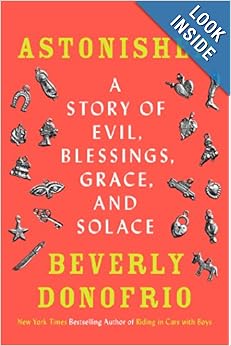
    Review: Astonished

    Astonished: A story of Evil, Blessings, Grace, and Solace.
    by Beverly Donofrio
    ISBN: 978-0-670-02575-6
    Penguin
    US $25.95
    CAN $27.50


    In an age of mashups, it is no surprise that there are spirituality/religions mashups. But when a memoir is about a person questioning her faith, mashups make it difficult to know which faith or religion is being questioned.

    Astonished is a harrowing painfully-honest book about a rape. It is full of questions,and these questions are hard, silly, difficult, or just weird depending on which aspect of her syncretist religion Beverly Donofrio is questioning.

    She is primarily a Roman Catholic and thus she understands that Christ has also suffered, but she is a Buddhist and a yoga practitioner as well. In addition, her parental issues --especially with male members of her family-- flavor her Catholicism with a Marian worship.  Yet, that honoring and worship of Mary (as the feminine aspect of God) is uncomfortable with the masculine expression of Deity.

    A book such as this is a hard read-through for many reasons. Books about rape are painful. As are books about depression and grief. Such books require commitment of heart as well as of mind. And spiritual memoirs will always encounter the spiritual boundaries the reader has set up for herself. But there is something to be said about the author’s bravery at showing her naked self. If Christianity is defined as walking with God and living a transparent life with human beings, Donofrio could be defined as a Christian. Of course, some will argue that that kind of definition is certainly not what Christianity is not. Or possibly that Christianity is that and much more.

    But what is one to do about the harrowing rape? It stands squarely in -- and is the sole cause-- of the book. To dismiss the events of the rape because of the funky self-chosen buffet theology is to be unloving.  

    Donofrio’s is a theology that is rooted in her own self, a spirituality that is one-sided because of that. It also has a very Augustinian Calvinism in that it has an almost fatalistic conception that God controls (or doesn’t control) evil. Only a modern Calvinist would speak of “forgiving God.”  Indeed, many of the questions Donofrio asks comes from this confusion of spirituality and certainly would not have been asked if she were more theologically rooted in the Bible.  At one point, she writes, “I’ve one friend who thinks I’m a Christian because I’m so desperate to believe in an afterlife, I’m willing to believe a myth-- that Jesus is the son of God sent to die in reparation for Adam’s sin of disobedience. Which then opened the gates of heaven and gave us eternal life.” She then goes on to say that the only part of the myth she believes is that Jesus is the Son of God and that she “believes in karmic law and reincarnation….I refuse to believe that God punished the whole race for Adam’s sin-- or that God punishes ever.”’   This muddled theology which believes that Christianity declares that God punished the whole race (a misunderstanding of the theology of the fall of man) and which believes that God doesn’t punish anyone is just one of many such instances one encounters in Astonished. It shows a buffet spirituality which picks and chooses elements of several religions, without quite being knowledgeable enough to see how the discarded parts and the retained parts are interconnected.

    If one would compare the pure white wedding dress given by Christ to His Bride with the self-made patchwork dress of one who supposedly believes. The dress is beautiful and even has patches of white but it is not a true wedding dress.

    Those who read religious books have strong opinions rooted in their own theologies or denomination and those who are not religious have their own prejudices against any work that is blatantly religious. Therefore Donofrio is to be commended for bravely discussing both her spirituality and the rape. On the one hand, the theology -- or rather, the many theologies-- in Astonished are so typically narcissistic Hollywood and so self-created and messily syncretist that one cannot call it a Biblical Christianity and there is a dangerous wolf-in-sheep’s clothing quality to it which could taint the spirituality of some readers. This book falls into the category of spiritual memoir and thus those who are lovers of memoirs or are connoisseurs of spiritual journeys will like this book. Those who have endured suffering or had spiritual questions may also like it. Those who understand the richness of Christianity will find it laughable.


    Saturday, March 08, 2014

    Review: Gift of Faith


    Robert Fleming's new book Gift of Faith is the first in a series to be published by Urban Christian. It is also his first foray into Christian fiction publishing. As, such, it is quite unlike the other novels he has written in the past. Gift of Faith tells the story of a pastor who suffers a terrible tragedy at the hands of his wife. The question the pastor is left with is: What kind of woman would do such a thing? The narrative follows the pastor as he discovers the true nature of his now dead wife, grieves for his wife and his dead children, comes to grips with his own encounters with human evil, and is slowly restored to hope and faith as he starts a new life.

    Throughout the novel, one encounters evil in its many guises, especially the evil that appears in the urban Black community. Thus the pastor understands evil through looking at his own tragedy but also through his ministry in the Black Church. The book is unflinching in its depiction of sexual sins and the temptations and sins that beset those in the religious community.Time and time again, he counsels (or tries to counsel) the grieving, the sinful, the addicted, the obsessed, and begins to understand the subtle interweavings of evil, mental illness, neediness, sin and the plainly demonic.
    Gift of Faith is a good book, but it is not excellent —and it does not compare well with Mr Fleming’s secular works.  There are several flaws that will trouble or distance the nonreader of Christian fiction, and there is one issue that Christians who read Christian fiction might argue with theologically or doctrinally.

    The first flaw is that the novel is told in the first person. While Christian memoirs and testimonies are generally taken at face value, a work of fiction needs to have the ability to convince most of its readers. Readers of Christian fiction will readily accept a narrator speaking of his humility and holiness but those not used to this genre would be more convinced if the story had been told to a third person narrator. Because of the first person narrator, the hero’s goodness and self-praise is not easily proven or acceptable. Moreover, many discoveries made by the hero seem as if written to show his own righteousness, thus the story’s climax is challenged by a seemingly unaware and proud hero. A story about a good person is rarely told well from the first person’s (the selfsame good person’s) point of view.
    For instance, lines such as, “The congregation was hanging on my every word, my every indictment of them” can be problematical.
    The second flaw (and again this is a flaw that would trouble only those who are not readers of Christian fiction), is that the author shows moral growth instead of emotional growth. Indeed, there is often a preachiness that —while acceptable and even expected in Christian fiction— makes the narrator hero appear coldly detached in spite of all his declarations of grief. One expects to see the narrator walking through his empty house missing his murdered children but no such events or scenes is given the reader.
    Instead, the author brings in several situations and characters to illustrate the moral quandaries that Christians —especially pastors— often face. As a pastor, it is understandable that these encounters would occur and that they would affect his theology and his recovery. The emotional arc is quickly swallowed up by the moral arc, and because the narrator already knows the spiritual answers to life, there is no emotional hook to draw us through to the novel. One moves from spiritual insight to spiritual insight, from moral lecture to moral lecture and in the end, the only answer the pastor finds are answers that show how evil his wife was and how good, holy and trusting he was. Because of this the book not only feels disjointed but one almost begins to feel that the wife was trapped in a marriage with a cold pious man with no heart. The author does not seem to be aware of this pitfall, which makes the read an uncomfortable one.

    Again, these are problems that would only trouble those who are not used to Christian fiction. However, there are some moments that will trouble some readers of Christian fiction. Some readers may not like the honest brave description of sexuality and sexual situations. Urban Christian books, written by Black Christians, are often different than Christian fiction published by mainstream Christian publishers such as Bethany and Thomas Nelson. Thus readers of urban Christian fictions will not be too surprised or offended at the truth in many of these scenes.

    However, some Christians — Black or White— might have a problem with a kind of fatalistic Calvinism that appears throughout the book, as evidenced in the following line:

    Mr Burke realized his fate was sealed. He knew he was going to get a harsh sentence for killing the woman, a wife and a mother of a young child. The elders often told me that we are destined to fail during this life, that we cannot always measure up to the standard set by the Lord. I know this is true. We all know that. We are all sinners.
    The apparent theological reasoning behind this is to show human imperfection and the inability for anyone to live a truly perfect life. It also  seems to show a compassion for human failure. But the words “fate” and “destined” so close together hint at a deeper Calvinist idea which the writer may or may not intend.
    If one looks at the Bible, this seemingly compassionate idea of being destined to fail comes off as merely human sentimentality. For the Bible declares:
    And he gave some, apostles; and some, prophets; and some, evangelists; and some, pastors and teachers; For the perfecting of the saints, for the work of the ministry, for the edifying of the body of Christ: Till we all come in the unity of the faith, and of the knowledge of the Son of God, unto a perfect man, unto the measure of the stature of the fulness of Christ: That we henceforth be no more children, tossed to and fro, and carried about with every wind of doctrine, by the sleight of men, and cunning craftiness, whereby they lie in wait to deceive; But speaking the truth in love, may grow up into him in all things, which is the head, even Christ: Ephesians 4:11-15
    And you, that were sometime alienated and enemies in your mind by wicked works, yet now hath he reconciled In the body of his flesh through death, to present you holy and unblameable and unreproveable in his sight: If ye continue in the faith grounded and settled, and be not moved away from the hope of the gospel, which ye have heard, and which was preached to every creature which is under heaven; whereof I Paul am made a minister; Colossians 1:21-23
    The Holy Scripture in Scripture commands that we not allow ourselves to be moved away from the hope of the gospel
    Whereof I am made a minister, according to the dispensation of God which is given to me for you, to fulfil the word of God; Even the mystery which hath been hid from ages and from generations, but now is made manifest to his saints: To whom God would make known what is the riches of the glory of this mystery among the Gentiles; which is Christ in you, the hope of glory: Whom we preach, warning every man, and teaching every man in all wisdom; that we may present every man perfect in Christ Jesus:  Colossians 1: 25-28
    Indeed, Christians are called to be conformed to Christ:
    My little children, of whom I travail in birth again until Christ be formed in you, Galatians 4:19
    This book has been accepted in many Christian bookclubs, including Urban Christian His Glory Book Club. It will no doubt speak to many who have suffered family tragedy. It will also be enjoyed by pastors, deacons and elders, because it shows the trials they encounter in their work. I recommend this book for those who are used to reading urban Christian. fiction. For those who are not used to reading such books, I would recommend reading Mr. Fleming's other books such as Fever in the Blood and Wisdom of the Elders, books which show the excellency of Mr Fleming’s skills at honestly depicting the problems and wisdom of the Black community. I look forward to seeing how Mr Fleming will merge the honest searing skill of his secular work with the requirements of the Christian genre. I have no doubt his next book in this series will be a better read.

    Saturday, March 01, 2014

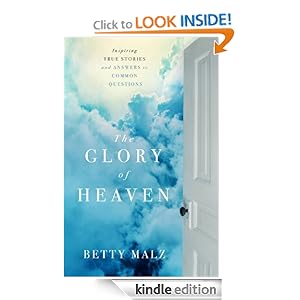
    Review: The Glory of Heaven

    The Glory of Heaven
    Betty Malz
    Those familiar with the writings of Betty Malz are probably aware of her life-changing life-after-life encounter on a sickbed. That encounter changed her life and began her journey of discovering, describing, and collecting supernatural Christian stories of near-death encounters or angelic incidents.
    The Glory of Heaven is an easy accessible conversational read. Bible quotes, inspiring stories, and discussions of heaven are interwoven throughout the book. What makes it different from other books on the same topic is that it is like over-hearing a "what-if" discussion of heaven. There is something dreamlike and meditative about it. The author uses old hymns, contmporary songs, Bible verses and the near-death stories to extrapolate on what heaven might be like. It is not argumentative or pushy. It's full of Biblical anticipation and will remind readers of the verse, "Where your treasure is, there will your heart be also." She expands the readers' minds and pushes away the sentimental ideas of angels playing harps on fluffy clouds thus making heaven a more real place, a true looked-for home for the Christian.
    In chapters that explore home, transportation, companions, she establishes our heart on heaven. The chapters on the "no mores" is especially inspiring.
    The Book is available in print, ebook, and on itunes.
    Highly recommended, especially for sunday school discussions.

    Thursday, February 27, 2014

    Review: Slated by Teri Terry

    Slated
    Teri Terry
    Nancy Paulsen Books
    352 pages
    www.penguin.com/youngreaders
    ISBN 978-0-399-16172-8
    $17.99 ($19.00 CAN)

    Slated is a dystopian young adult book which takes place some thirty years in the future. Unlike many dystopian books, the world depicted doesn’t differ in major ways from ours. The differences in this UK is not easily or immediately seen but they are there. There are terrorists, missing children, government anti-terrorist groups, untrustworthy officials, mental hospitals and --oh, yes!-- Slated children. The “slated” are people, usually children, who have had their memories erased as punishments for crimes. These slated people are kept in hospitals until they are deemed ready for the outside world. After they are released (or semi-released) they are placed in schools and families in the hope they will fit into their communities. The Slated, of course, have forgotten their past lives and most are happy at their second chance of life. However, sometimes slating doesn’t quite work. . . especially if one is special, like Kyla Davis.

    The world depicted in the book is recognizable, probably too recognizable. Slated is never boring but something is lacking --not merely the main character’s missing-but-slowly-returning memory.The enjoyment of Slated depends on what the reader is looking for. Slated might seem slow and unsatisfying for those who seek out speculative fiction for the joys of worldbuilding. Those who like a mystery will find the reveal at the end of the book unsatisfying, too little too late, or a bit “meh”. But those who are interested in the psychological ramifications of trusting others or of navigating a larger and unknown culture will like it.

    The main character’s lack of memory makes the story claustrophobic and helps turn a sci-fi dystopian story into a mystery. Not so much a Who-done-it? but a What-might-I-have-done? Who-can-I-trust? And-who-am-I? The main character is placed in a position where she has to accept many “givens.” Whether adopted into a family or born into it, the typical teenager understands how she fits into the household. Not so Kyla who has to take the word of her handler, Dr Lysander, about her new family.

    Learning to navigate the spectrum of trust is often examined in art but Teri Terry includes the additional teenage coming-of-age trope of self-discovery.  The main character Kyla has to integrate herself into a culture she doesn’t understand while being essentially an alien or an isolated immigrant. She has to figure out how to figure people out and to learn who really wants to help her. The subtext of being an immigrant is also accompanied by the subtext of being learning disabled.  Anyone who has ever felt like a stranger in her own skin or who has felt somewhat lost and confused about the world will understand the character’s battle.

    Much is revealed in the last sections of the book and much is left hidden from the main narrator, and thus from the reader. The main character has discovered her true self and now understands who is (or has) been trying to manipulate her. She has a goal now. Her goal is not to save the world or to discover the extent of the government manipulation. For all she --or the reader-- knows, the problem is global. But the goal is important to her, and the goal is enough to make the reader reach for the entire trilogy. Slated shows the best and worst aspects of the first book in a trilogy. The character’s goal has been prepared, the journey begins. But the author chose to hide much of the story until the end, which feels somewhat manipulative. Still, it’s a good book and adults and teenagers who like dystopian trilogies should like it.Recommended.   

    Sunday, February 23, 2014

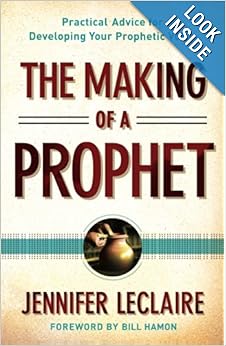
    Review: The Making of a Prophet by Jennifer LeClaire: Practical Advice for Developing Your Prophetic Voice

    Review: The Making of a Prophet: Practical Advice for Developing Your Prophetic Voice
    by Jennifer LeClaire
    Chosen Books
    Baker Publishing Group


    The problem with Jennifer LeClaire’s The Making of a Prophet” is that she doesn’t believe God answered Moses’ prayer: “Would to God that all God’s people were prophets!” It is not the only problem but it is the main one from which all the other problems grow.

    The hint that LeClaire lives in the Old Testament paradigm of certain special people called to guide nations, ministries, leaders, because of their spiritual gifts begins early in the book. At page 16, she writes “perhaps you are consistently seeing revelatory gifts- such as words of wisdom, words of knowledge, and discerning of spirits-- manifesting in your ministry. That gives you a hint of your Kingdom vocation.”

    By the time one reaches page 136, where the author shows her belief that those who are part of the prophetic ministry get more spiritual warfare than regular believers, one has about lost one’s patience with all the specialness and the Old Testament model of how God’ gifts works. The idea that God has poured out his spirit upon all flesh gets lost in all this prophetic specialness. While Paul writes that all members in Christ’s body are equally important -- with the “eyes” that specialize in seeing, the ears, the mouth, etc--  LeClaire takes many of the charismatic gifts mentioned in the New Testament and gives them all to the prophet.  Although LeClaire is not Catholic, there is a deep sense here of the Catholic idea of clergy --who all do important things in the church- and the lowly laity who are acted upon by the prophet. Indeed, the prophet of LeClaire’s vision seems answerable only to the pastor, but even then the prophet must be wary of dangerous pastors who may not understand or who may distort or envy the prophet’s vision. This kind of mindset goes counter to God’s idea of parts of the body being dependent on other parts. Although St Paul separates those who have the gift of prophesy from those who have discernment, etc, LeClaire hoggedly usurps all these gifts, thus making the specialized office of prophet way more self-sufficient than Paul does. While St Paul speaks of those with gifts of discerning of spirit, or those with gifts of healings, LeClaire lists prophetic intercessor, prophetic deliverance minister, etc.  LeClaire writes that she discussed her fears with an apostolic mentor. It is unclear who this apostle is therefore this reviewer found it difficult to accept that apostle’s say-so about spiritual warfare. While the apostolic ministry still exists, Christians must be wary of calling anyone an apostle. The signs of an apostle are many and one of them -according to St Paul 2 Corinthians 12:12--is that an apostle is one who has done great signs and wonders including raising someone from the dead.  

    Interestingly, the book would be good for all Christians. It shows all the challenges that come to those who believe the Word of God. Jesus declares in the parable sower that persecution comes because of the word, but LeClaire continually seems to insist that these trials are worse for the prophet.   

    One of the charismatic gifts is the gift of faith - the gift of speaking forth a thing and commanding it to come. LeClaire speaks mostly of the revelatory gifts however. So there is an imbalance.  

    This book is almost a spiritual equivalent of the YA book, Divergent. It talks about the specialness of a kind of people. Unlike other books such as Seeing the Voice of God by Laura Harris Smith or You May All Prophesy by Steve Thompson, ---books which help the reader feel equal to the writer and which are about the working of the Holy Spirit in all of God’s people-- LeClaire’s book is a subtly disguised paean to herself and uniqueness. Whereas those books teach from their author’s unique experiences but somehow seem universal, this book is for everyone, but it doesn’t think it is.  The Making of a Prophet purports to be a charismatic book but it could easily be a sermon written by a non-charismatic about the pitfalls of ministry.  


    Blog Archive