Saturday, February 11, 2017

2017 Oscar Nominated Shorts -- Documentary

4.1 Miles
 
This joint US-Greece short shows the efforts to save refugees coming in by boat from the Middle East via Turkey. I was on the verge of tears watching this. The film is effective in showing how complex the whole humanitarian crisis is. Weeping children, many of them orphans, caring but wary Greeks who feel their island is being overwhelmed, especially because there is no infrastructure on the island to take care of sick, homeless refugees. A very sad but important watch. I suspect that even people who are hateful toward Moslems would be touched.   
 
 
Extremis
I think I needed a trigger alert for this documentary. The focus of this story is on people in ICU in Kansas who are not going to recover from their illnesses. These people (if they are able, or if their families are willing) are given the choice of living or dying. Sometimes living implies being in a vegetative state until the body gives out. It's definitely a study about the ethics of medicine. This is a very, very, hard watch.  
 
 
Joe’s Violin

This is very touching. After a NYC radio station starts a musical donation drive, many people donated their instruments. This story is focused on a holocaust survivor who is giving up his beloved violin. Music meant a lot to him before the war, while he was in the displaced person's camp in Siberia, and after. He donates the violin to a young girl and they become friends. This girl also has endure some suffering of her own.  This is a very inspiring documentary. I was weepy throughout.
 
The White Helmets
 
Among the bombed-out houses and shelters in Syria are a group of people called the White Helmets who go through the rubble to find survivors and bodies.  It's another hard watch. It's just very difficult seeing all that suffering, but it's inspiring to see how brave these first-responders are. This is yet another film that those who dislike refugees should see.
  
 
Watani: My Homeland
 
 This depicts the life of a refugee Syrian family as they try start a new life in Germany. It's hopeful but felt slightly like propaganda. Unlike the previous refugee films where we are in the middle of a distressing situation, this film has time for reflection and even a bit of a happy ending. The conversations tend to be the kind of talk one hears when one is aware that others are watching and that one needs to say certain appropriate things. Perhaps because of this and because of the slickness of the finished production, everything recalled in tranquility, the film feels like any old documentary one might find on a news program.

What Should Win: Joe's Violin or 4.1 Miles.
 
 
In Theaters February 8th and On Demand February 21st
 
For a full list of theaters the short films are playing in, visit:
 
For information on how to watch On Demand, visit:

Watch the official trailer:


2017 Oscar Nominated Shorts -- Animation


Blind Vaysha
 
The plot of this story is simple. A girl, Vaysha, is born with one eye that sees only the past and another eye that sees only the beautiful. Although the village women try to help her, she never sees the present. This modern fairytale from Canada merges the philosophical and the fantastical, which is what the best fairytales always do. Watching the artwork is like watching a living ancient etching. An animated film that will cause much discussion among filmgoers of any age. This should win if the Academy members decide to go for a deep story.
 
Borrowed Time

In this US short, a son recounts the tragic events that led to his father's death. A tragedy which he caused but was not responsible for and which has haunted him since that day. The cinematography  is breath-taking. The script is crisp, powerful, and heart-rending despite the sparse dialog. A lot of emotion and beauty in this 6-minute film.  Definitely not for kids. 
 
Pear Cider and Cigarettes
 
 This joint Canadian and UK noir has spectacular linear art, very reminscent of comic books. The story is excellent, the narration world-weary. The entire thing is stylish. But it bored me. Perhaps I'm burned out on good-for-nothing self-destructive types, but after a while I didn't care enough about the antihero and I kept wondering why such great art was being wasted on such a character. Perhaps it's the literature major in me but I've just seen too many stories about loser/users to care. This story added nothing new to similar stories and the backstory of ant-hero's life didn't give the viewer any reason to care about or understand him. So, while his friend the narrator was well-acted and worn down, the story seemed as inevitable and predictable as the anti-hero's path towards death.   
 
Pearl

This American short about growing up, bonding, and paternal love is very sweet but it says nothing new. In it, a young girl realizes how much her father has influenced her. The color palate of the film is very painterly, giving the viewer a rhapsodic pastel rush of fleeting, nostalgic, images.

Piper

 This is a Pixar joint and it is utterly adorable. I had a big grin on my face. It's cute, hopeful, joyful, lovely...and it has a cute little baby bird. Yes, the cuteness factor is off the charts. Academy members who like cuteness should love this.

What Should Win: Blind Vaysha but I wouldn't mind if Borrowed Time or Piper won.


Friday, February 10, 2017

2017 Oscar Nominated Shorts -- Live Action


Ennemis Intérieurs (Enemies Within)
 
Ennemis Interieurs is a story that takes place for the most part in one setting: an official's office. But that particular setting resonates in its universality and specificity. Most people, in most places have been in this type of setting. Who has not had to meet a bureaucrat at some government office? But the setting is also specific and immigrants, religious and ethnic minorities, will feel the resonance in their own way. 
 
The basic plot is this: An immigrant who has lived in France most of his life has decided to become a citizen. He is interviewed by an official who seems at first to be more a gatekeeper or police agent than a welcoming immigration office. 
 
This is one of the most harrowing short-shorts I've seen in a while. Even more harrowing than the many horror shorts I've seen. And the reason it's such a hard watch and such a painful slow burn is not because of the inherent creepiness that occurs when one sees someone being interrogated in a tiny room by a cold meticulous official bent on tripping one up. It's because one finds one's self getting angrier and angrier as the cruelty becomes more pointed and the trap becomes more inescapable.  It's been ages since a film villain has made me so angry. Most villains in movies are cool and we filmgoers generally admire their sang-froid and cold-heartedness. But the citizenship inspector is so reminiscent of that powerful real-world prejudiced villainous official who is hell-bent on destruction.  In this character, we see how pernicious, subtle, and vicious the prejudices of the powerful are. Highly recommended.   
 
 
La Femme et le TGV (The Woman and the TGV)

A woman whose life is passing her by is holding on to the past --its elegance, its proprieties, its routine. Part of her daily routine is waving out the window at a passing train -- the TGV. She has not greeted the new things of life -- things such as the internet, or people like the playful young guy who dared to park her car in front of her bakery. But then, one day, a letter arrives and it is from someone on the train. He has seen her waving everyday and he writes to thank her that he values that very human action. She answers that it is a habit she formed with her son in the old days. However, this new interaction with this unseen letter-writer becomes the catalyst which causes her to grow out of her old ways. 

I liked this film a lot. I can't say it is anything super-special, so I'm somewhat surprised that it is nominated as a short. After all, there are countless movies and shorts about people encountering something, event, or action that causes some life-changing momentum to be set in place. Perhaps I'm missing something about the film that makes me unable to see it's greatness. Perhaps it has national or cultural echoes --the death of small-town France, for instance. But I won't hold its simplicity against it. It is a sweet little short with a solid story and good cinematography.
 
 
Silent Nights

Every once in a while one comes upon a movie where one has a disconnect with the filmmakers. For me, this was such a movie. The story is about a young woman in Denmark who is working in a homeless shelter for poor legal and undocumented immigrants. She encounters a homeless man from Ghana and falls in love with him.  Because of this encounter, the man leaves Denmark with lots of money and the woman is left alone happily fulfilled with his child. Perhaps the blurb is to blame, which reads as: "The couple builds a life together, but a devastating secret from Kwame's past may undermine their happiness." SPOILER (which is not really a spoiler): The Ghanaian man is married with children.

There are countless reasons why this movie annoyed me. The primary one, however, is that the music cues us to like the Ghanaian. Musical cues rarely work when a story is so facile. The writer in me wants sentiment --especially the sentiment of pity-- to be earned. In the end, the story comes off as a tale about a naïve loveless White girl who is taken advantage of by a Black man. Which is fine. But this is not what the filmmakers intended. The depiction of the immigrant is patronizing, his adultery is glossed over and repaid by monetary gains. The girl comes off as a dupe, and the film as self-congratulatory and simplistic. For me the story should have been more subtle and more morally complicated. For instance, is it possible for a poor man to love a woman who is giving him financial help and who ends up providing him with sex and a place to stay? A story like this --told in times like this-- should leave the viewer feeling troubled and perhaps confused.  
 
Sing (Mindenki)

This Hungarian short is utterly a-political, yet profoundly political. Unlike the failure Silent Nights and the pointed and devastating Enemies Within, Sing shows in a small setting -- a primary school-- that the political is often quite personal and that communal power (however small) can overcome evil....if only on a small scale. The story concerns a school choir, the choir mistress, and an upcoming contest which the choir mistress desperately wishes to win.  The choir mistress is not below using cruelty to get her way. What I loved primarily about this film was its kindness, its unobtrusive but powerful subtext, and its efficient storytelling. It may not be as devastatingly powerful as Enemies Within but it says a lot about how power could be challenged. I highly recommend this little short.
 
 
Timecode

This short from Spain manages to be primarily about dance. I wouldn't necessarily call it a dance film, however. The dancing is interwoven like beads on a very thin plot string. But it works so well. The main characters are two guards who never speak to each other -- at least their communication is not verbal. They pass each other like ships in the night; dancing ships. The only verbal communication between them are the camera timecodes they exchange, timecodes which give each other clues to when and where their dance communication takes place. A good short, and like any good dance flick, the culmination of the story and the dance work perfectly together.
 

Thursday, February 09, 2017

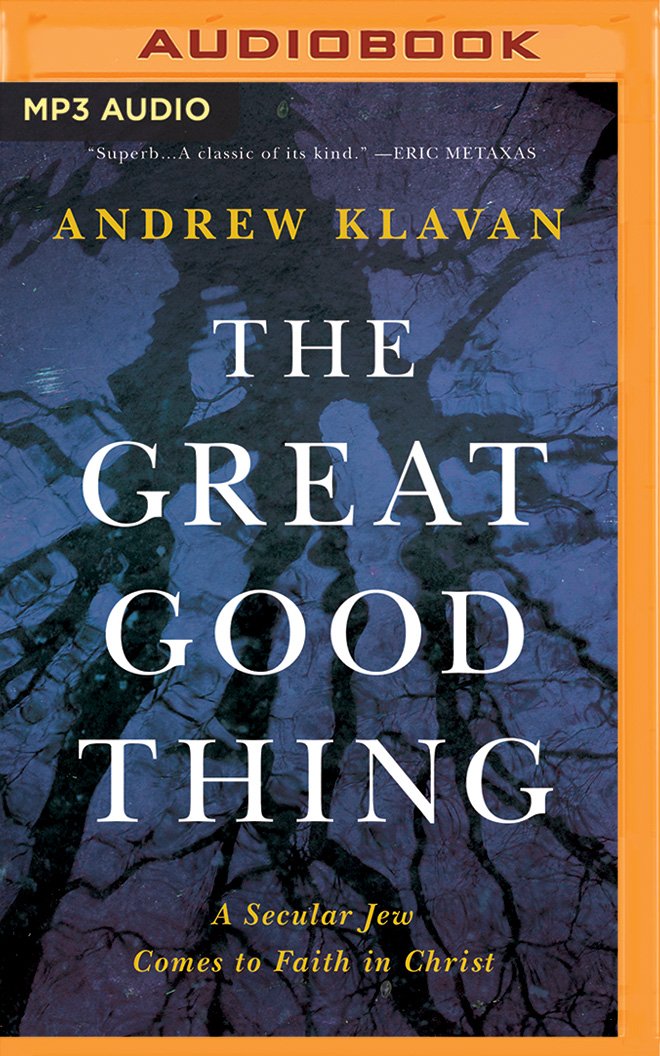
review: The Great Good Thing by Andrew Klavan

The Great Good Thing: A Secular Jew Comes to Faith in Christ
by Andrew Klavan
  • Hardcover: 304 pages
  • Publisher: Thomas Nelson (September 20, 2016)
  • Language: English
  • ISBN-10: 071801734X
  • ISBN-13: 978-0718017347
I really like this book. Usually I fear reading conversion stories that are published by large Christian companies. Often, they are ghost-written by a Christian ghost-writer and feels very cookie-cutter by-the-book. Often those conversion stories don't feel quite literary. And no, I'm not into literary memoirs, but there is something to be said for actually seeing the personality of the writer and knowing one is reading words that are chosen by the book's subject instead of words chosen or written by a ghostwriter. But hey, that's just me. The writer in me can spot sameness in any book and apparently, there's a Christian style of non-fiction/memoir writing.

Anyway, moving on.

Another thing that's good about this book is that feels as if it was written by an excellent writer. There is a self-searching and an honesty that is apparent in this spiritual memoir. The book is ruminative and revelatory and much care is taken to show the inner workings of the memoirist. He talks about having to push past his knowledge that his background might have set him up to reject his faith in order to fit into White Christian Culture. Because the writer of this book loves books, the memoir has many literary references as well as many dissections of emotional, psychological, and spiritual challenges on the way to his conversion.  And he's very honest about his challenges, giving -- so to speak-- "a knife to any reader who might wish to stab him with" some supposed 'reason' for his conversion.  Most Christian non-fiction --in my experience-- just isn't that honest. And that's what I liked about this memoir.

One of the challenges he mentions was when he had that moment, the false epiphany of "No God." It reminded of what happened to William James, Henry James' Brother. If I recall, James had been walking through life when suddenly it occurred to him that God did not exist. It was such a sudden realization that it freed him, supposedly. Except that Klavan couldn't rest in that sudden (false) realization that God didn't exist. He pushed past it.

The book is very readable, insightful, and a great read. Highly recommended. I received this book free from the publisher in exchange for a fair and honest review.


Sunday, January 29, 2017

The Fan: A Boy Goes on a Journey

THE FAN -- So...this happened: A Boy Goes on a Journey
By Carole McDonnell

Hello, all:


One of the chief joys of journeys is the joy of simply zoning out from one’s own mind and entering into the swiftly (or slowly) moving passing present. The joy of being in the happening, especially if the happening is new, emotionally involving, and promises a fulfilling destination. Here now are the latest fan journeys from the Fan, a collection of squees definitely come from a fan girl’s heart.


Train to Busan, Korean, 2016, horror-thriller.  Directed by Yeon Sang-ho, Produced by Lee Dong-ha, Written by Park Joo-suk; Starring Gong Yoo, Ma Dong-seok running time: 2 hours.


The first thing you oughta know is that Korean films and TV shows are very spiritual. Even films that are revenge thrillers are bound to have a redemption arc or two. You can’t escape it. The second thing you ought to know is that this is a film about a zombie outbreak on a bullet train. A sudden zombie outbreak. I say this because your typical American film about an outbreak of zombieism tends to concern itself with the day after. In Train to Busan, the survivors are suddenly overwhelmed by sudden disaster. Maybe it’s the effect of living in the fearful shadow of North Korea but the film gives off a great siege mentality, sudden psychic trauma vibe.


So, our story begins with Fund Manager, Seok Woo who pretty much represents greed and selfishness. Korean films, of late have been way concerned with greed and greediness. Seok Woo has plans for himself and his daughter Su-An. They end up on a train with Sang-hwa and his wife Sung-kyung, who is pregnant, two older women who are sisters, a rich guy, a high school baseball team, two lovers, and a mysterious homeless man. These folks all represent different levels and permutations of selfishness, altruism, and self-sacrifice. And then, the zombie rage and neck-biting begins.


And the munchies have not only affected zombies on the train, but it’s all over. Why? You may ask. Well, pay attention to the first ten or so minutes and you’ll get an idea of why things in Seoul and the rest of Korea have come to such a pass. (I can’t say anymore; I only write spoilers when there is absolutely no chance you’ll be watching a film.) So..upshot? The train can’t just stop anywhere. Coz, ya know: zombie roamers, zombie rioting. And right now the only place that seems safe is Busan, the other big city in Korea. (Oh yes, something else about Busan that we Korean dramaphiles know: Busan is a bit like the anti-Seoul..and often equated with country folks and the working class but also with gangsters. So much so that gangsters from all over Korea routinely train themselves to speak in a Busan accent. But who is the real lowlife? The sophisticated Seoulite or the working class guy? Who is the better person? And who is the useless person? Does money truly make the man?


Of course part of the fun of a horror movie is seeing the different kinds of kills and wondering if your favorite characters will make it. I won’t tell you who all makes it to the end, but I’ll warn you that since this is a Korean movie and Korean directors love devastating viewers, it’s best you don’t get too attached to most of our main characters. Just saying: Korean women seem to like crying. So, yeah, there’s that.


Let me tell you, Dear Reader and Cinema-phile, this is a great two-hour thrill-ride popcorn flick. (There’s an animated sequel called Seoul Survivors which I didn’t get a chance to watch which is probably just as much fun...and more so because, yeah...animation. Animated bodies in horror can do mega-more interesting stuff. Yeah, I really should find that film and watch it as well.)


We have redemption arc, we have guilt, we have bromance, we have moral and immoral decisions, bonds broken and made, we have unexpected deaths (okay, they’re only unexpected if you don’t know Korean thrillers, and the last two minutes of the film really had me wondering if nihilism or optimism would triumph. I won’t tell you what wins.) There are two villains, one more overtly villainous than the other. Incredibly nasty-villain comes to an appropriately nasty ending, and not-so-overtly-nasty villain has his moment of redemption. And yes, we have zombies on a train.


What I liked about this flick -- other than being able to see a couple of my fave actors in Korea’s first zombie flick-- is the simple but great worldbuilding. We need to understand only a couple of facts about zombie life and our main characters. Once the audience understands how your typical zombie behaves under certain situations and who is selfish and altruistic, we’re off and running. And yes...I do mean “running.” Because not only are the survivors running but this is one extremely fast-paced flick. Highly recommended.


Kubo and the Two Strings -- Written by Marc Haimes and Chris Butler. Directed by Travis Knight. Produced by Laika Studios, 102 minutes, United States, August 2016


Kubo and the Two Strings is a stop-action animation film with one of the most engaging characters I’ve seen in a while. To begin with, he is a very loving and caring child….with one eye. What a sweetie! I can’t remember the last time I saw a film about a loving, caring, little boy. I know this might seem like a strange reason to love a movie but think of it...we don’t see care-giving little boys in films nowadays where caregiving is the child’s major role. And we certainly don’t see it in animated films. Of course the typical hero of old is often selfless, filial, and noble, but he’s usually busy on his hero’s journey; his caring qualities is part of his subtext and only arise when he needs those weaker than himself.


But not Kubo. Kubo’s sole, selfless, purpose in life is to care for his mother -- a mother who is not entirely emotionally-present….unlike the totally absent-but-perfectly-healthy doting moms in the typical fairytale or Disney films.  That alone makes Kubo unique. He’s a sweet kid and we simply love being with him on his journey. And what a sweet, lovely, magical journey it is! This is a beautiful, fanciful story. And “fanciful” is always fun.


The Poet Emily Dickinson wrote, “A poem should not mean, but be.” Sometimes being and mere experience are all that’s needed; meaning can be unnecessary --or worse-- an intrusion. Kubo and the Two Strings is a storytelling experience about stories. Or maybe it’s about journeys. Or maybe it’s about memories. But, wonderful little film that it is, it would probably have excelled to awesomeness if the screenwriter had not tried to wrestle meaning into it. I have no problem with meaning. Let me be clear about that. What I have a problem with is the sudden infiltration of an attempt at meaning which feels tacked on, awkward, preachy, and over-reaching. An example: some night-time dreams are clear, others are utterly incomprehensible yet they still manage to touch the deepest part of the dreamer’s soul and make the dreamer feel as if she has touched the numinous. Kubo’s beauty comes from its characters, its matter-of-fact fantasy, its mundane otherworldliness, and its depiction of emotions as powerful as love and grief.  So, yeah, I kinda wish the storyteller had not felt the need to tie so much of his story into a neat little bow.  I suppose the “creative powers that were” felt that a good children’s story should have its meaning stated explicitly. I’m not sure, though, that meaning --explicitly stated or otherwise-- is all that necessary. Kids tend to be more interested in characters...and their journeys..than they are in the meaning. One of my favorite stories, The Day Boy and the Night Girl by George MacDonald, is downright inscrutable. But it haunts me still….But “still” Kubo is haunting in its own way. Just not as haunting as it should be.


Now, We’re Alive (Et Maintenant, nous sommes en vie)  2014, French, Thibault Arbre (Writer, Director, Producer).  Giles Daoust, Producer. Amazon Prime.


I happened upon this movie either by sheer luck or by trained intuition. Give me a film synopsis, and I can pretty much tell (most of the time) what I’m in for. Well, imagine my surprise when I found myself being flummoxed as I watched this little French spec-fic indie. Like all my fave films, it’s a slow burn and folks will either love it or hate it. I loved it. Why? You may ask.


Because it’s a great example of a writer taking a speculative premise and running through its various ramifications. When the story begins, we are presented with Tom. Tom is twenty-five and as tradition dictates, he must find his wife. Or, rather, the voice of his soul. This is done by being blindfolded and placed in a room and listening to women (also born on the same day he was, fifteen years ago) speak. The voice of his soul, his true wife, will captivate him and he will know who he is to marry. He will, after that, go in search for her.


So, Tom does all this. He even has visions of the woman’s face. But, woe betide, he cannot find her and when a woman presents herself as the voice he has heard, he simply does not connect with her. This is seriously bad, culturally and familially speaking. An affront to sensible people, an offense to his father and to the girl’s family. But alas, Tom has to soldier on.


But he doesn’t necessarily do that. He becomes more and more attached to the vision of the woman --named Jeanne, perhaps-- whom he knows is the true voice of his soul. All the while, he ignores, sweet patient Lea. Question is: Is Jeanne a figment of his imagination? Is she some inner aspect of Lea? Is the tradition right or wrong? Should Tom just give up on his ideal and accept the woman in his bed? Is there such a thing as the perfect true love...or not?


I loved this movie. Why? Because Tom is so obsessive and so sure and I love an obsessed hero who believes in that one personal truth that no one else believes.


41, Director Glenn Triggs, Writer: Glenn Triggs, Science fiction, UK, 2012


So, there I was trying to resist my love of time travel movies. (For your benefit, Dear Reader.)  Then this film caught my attention. Nay, I dare say it jumped out at me. From my youtube screen. Let me add that for some strange cosmic reason there are a heck of a lot of movies out there with the title 41. So if you go searching for this flick, look for the indie-looking one made in 2012.


If you like indie scifi films, this might be up your alley as well. I suppose I should say --off-handedly-- that it is a bit like Primer. Bur seriously, what indie time travel film isn’t like Primer?  


Our story begins with Hayden in his philosophy class listening to the lecture ask those deep questions hip philosophy teachers always ask at the beginning of indie flicks. Our premise subtly (or not so subtly) placed before us, we next see Hayden meeting himself. He warns himself not to go to a certain motel and not to go to room 41. But, do I even need to say that he ends up there? Of course not. People never heed the advice given to them by their time-travelling selves. Turns out there is a hole in the floor of a certain hotel room which leads to “the day before.” The next thing we know, Hayden’s ex-girlfriend --whom he bumped into at the motel he wasn’t supposed to go to-- ends up dead. Problematical. One: because the cops blame him for it. And two: because try as he might to prevent the death, his former girlfriend always ends up dead and he ends up with various versions of himself. What to do? What to do?


Ya know...ya know...this was a fun movie. Hayden’s repeated attempts to repair yesterday of course lead him to the answer to the life-question posed by hip-trendy professor. But it’s not the life question that mattered for me, it was the journey and the people Hayden met along the way.


Monday, November 28, 2016

Review: Soframiz: Vibrant Middle Eastern Recipes from Sofra Bakery and Cafe

Soframiz: Vibrant Middle Eastern Recipes from Sofra Bakery and Cafe
by Ana Sofrun and Maura Kilpatrick
                                                                                                                                                                                

  • Hardcover: 264 pages
  • Publisher: Ten Speed Press (October 11, 2016)
  • Language: English
  • ISBN-10: 1607749181
  • ISBN-13: 978-1607749189
Wow! What a great tempting book! Generally, I don't like cookbooks created by chefs who are giving readers their formerly secret recipes. For one, cookbooks made by chefs tend to be a bit pretentious and oriented toward the foodie types. For two, I generally hate food fusion...which a lot of these chefs do for upscale customers. For three, the books are often created to advertise the chef and his/her restaurant.

Well, imagine my surprise! This book has none of those drawbacks! Well, some of the dishes definitely look westernized but not to the smug foodie fusion extreme. I'm wondering if I should keep it -- because I may just try making (or looking for) everything in this book-- and I can't do that because I'm not really supposed to eat gluten.  

The recipes are of foods that are found in the Middle East. Think, Yemen, Greece, Israel, Iran, Morocco, and Turkey.

The chapters and categories are:
Breakfast
Meze
Flatbreads
Savory Pies
Cookies and Confections
Specialty Pastries, cakes, and desserts,
Beverages,
Pantry (which includes recipes for several basic Middle Eastern spices)
Essential ingredients
Friends and Resources
About the Authors
Acknowledgments
Index

The book is primarily about pastries, so there aren't a lot of meat recipes. But those that are present look so good! Meat, veggies, chocolate, dairy, nuts, seeds, fruits, flowers, squashes, and beans joined with different kinds of doughs to form breakfast, snacks/appetizers (or mezes) desserts, and larger meals. Then there are the beverages --namely three teas, one lemonade, and one hot chocolate!

Most of the ingredients are available in grocery stores but a few might only be found in your local middle eastern stores or via Amazon. Generally, the authors don't tell the cookbook user how nd what to substitute for the missing ingredient.

 The recipes are clearly stated and the pictures are temptingly beautiful. Most of these recipes are unknown to me. So don't expect to find recipes for stuffed grape leaves or tabbouleh. Yeah, I kinda wish they had included some of the foods we know...but you know...the real versions of them. But its a great book, nevertheless. If you're a baker, and you want to experiment with new kinds of pastry --the sweets and desserts in this book reminded me of Turkish candies-- definitely buy this book.  Or make it a present for the cook you know.

This book was sent to me free in exchange for a fair and honest review.


Tuesday, November 15, 2016

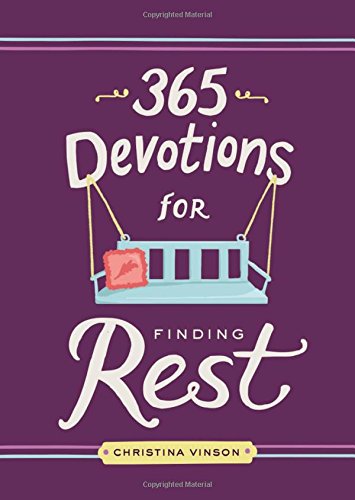
Review: 365 Devotions for Finding Rest by Christina Vinson

Review: 365 Devotions for Finding Rest by Christina Vinson

  • Hardcover: 400 pages
  • Publisher: Zondervan (November 8, 2016)
  • Language: English
  • ISBN-10: 0310083532
  • ISBN-13: 978-0310083535
I'm seriously amazed. I like this book. I generally avoid Christian non-fiction/self-help/spiritual books because hey, if you've been around for as long as I have...well, you already know a lot of this stuff and you're pretty impatient with newbie Christians straining themselves to tell you some new spin on Christian discipline, teaching, fellowship, living or whatever.

But honestly, this is a good book! I was trying to learn how to rest -- something we Christian women re very bad at because we re brainwashed into being active no matter what. (Although we are supposed to enter into Christ's rest.)

Anyway, I generally find Christian devotionals to be a bit shallow but this time I was pleasantly surprised. The writer assumes her reader is equal to her. She's not teaching down to you or being patronizing or uber-spiritual. And while the devotionals have insight and depth, they are neither pretentiously pseudo-deep nor watered down. The vocabulary is accessible.  The themes that are tackled re surprising. Whoever thought of having a rest from procrastination? I highly recommend this book for anyone --male or female-- who needs to understand the importance of resting.

I received this book free of charge in exchange for a fair and honest review.
 

Monday, October 31, 2016

Review: NKJV Study Bible


This Bible was formerly titled The Nelson Study Bible New King James Version. Copyright 1982, 1997, 2007.

I have a love-hate relationship with study Bibles. On the one hand, a new student of the Bible can get insights (philosophical, anthroplogoical, theological, spiritual, historical) into the verses and passages by reading the commentary. On the other hand, the human mind is a tricky thing. Bible students have been known to accept/merge the insights (wrong or right ones) into the passages and verses. Basically, if it's written on the page --even if it's not gospel-- it's taken as gospel. Depending on the denomination of the editor and publishing house, one can find some strange commentary. So yeah, we have to be careful about which study Bible one reads.

This Bible has the following features:
New King James Version of the Bible, Cross References with sub-headings and center column reference notes, Prophetic cross-references, Annotations (very accessible language), Introductions and Outlines to each Bible book, Time Lines, Articles on Christian doctrine, Bible time and Culture Notes, Charts, Word Studies, Maps throughout the book and Full-color maps at the back. an article on how to understand what the Bible means, Tools for Bible study, Teachings and Illustrations of Christ, Prophecies of the Messiah, Parables of Jesus, Miracles of Jesus, Prayers of the Bible, Subject Index to Annotations, and a Concordance. And, of course, a table of Contents, a list of Editors and Contributors, and Special Abbreviations..

The commentary on the thorn in the flesh ( 2 Corinthians 12) and the commentary on the gifts of the spirit (1 Corinthians 14) made me smile. I sometimes feel amazement, sometimes wonder, sometimes disgust, sometimes commiseration when I see how the commentators try to show their own viewpoints and interpretations. Thomas Nelson is pretty standard Baptist and although the editors and writers try to give as many opinions as possible, they often use the well-worn line "most interpreters agree,"( which is pretty loaded...after all we don't know which school of interpretations they are using) to direct the reader to their opinions and doctrines.  On the whole, though, it's a solid book. I did, however, find myself wondering how much they had updated the book. After all there have been so many new linguistic, historical, and archaeological discoveries since 1982. It doesn't seem to have been updated too much.

The type font is good. The Bible is solid, big and somewhat heavy but not unbearably so. The cover is aqua and dark blue pleather (I think) and there is one ribbon bookmark.
I got this book free in exchange for a fair and honest review.

Sunday, October 23, 2016

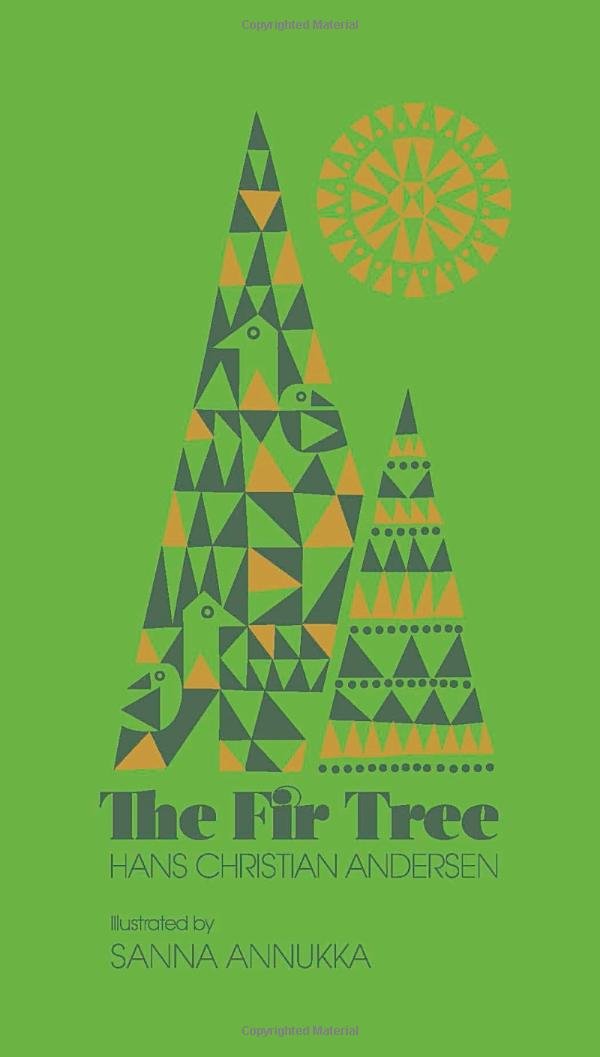
Review: The Fir Tree by Hans Christian Andersen illustrated by Sanna Annukka

  • Age Range: 4 - 8 years
  • Grade Level: Preschool - 3
  • Hardcover: 48 pages
  • Publisher: Ten Speed Press (October 4, 2016)
  • Language: English
  • ISBN-10: 039957848X
  • ISBN-13: 978-0399578489


I had totally forgotten why I disliked Hans Christian Andersen. After reading The Fir Tree, I remembered: Andersen is seriously melancholy. I don't think I have a problem with sad fairytales, per se. But I'm not sure about sad fairytales being told about young kids.

Ah well, I read the book. So I should  just suck up and accept the story.

First: story -- sad, melancholy, humanistic but vaguely nihilistic. It's a story about enjoying the good times while you're young because you'll end up getting old and being burnt.
Second: font and typestyle -- I found the font  bit small. Too tiny for tiny kids' eyes or for squinty grandparent's eyes.
Third: illustration -- beautiful, creative, ethnic tribal natural style, but somewhat cold. The illustrations don't really illustrate the story, they decorate it. Most kids would prefer seeing depictions of the various scenes and pictures of the characters mentioned.
Fourth: vocabulary -- an elementary school kid should be able to read this.

Upshot: I think this is a book for older people who like fairytales. Not for young kids.

I received this book free in exchange for a fair and honest review.


Monday, September 26, 2016

Review: The Dim Sum Field Guide


There's a Dim Sum place down the road from me. I've never gone because I get all panicky about how to do the whole Dim Sum thing. This book will definitely help me understand what I'm ordering. Plus, because it describes the foods so well, I'm thinking I could use it to make my own little tidbits.


Imagine you're out in the wilds of a Chinese restaurant, Asian Market, or Street Vendor and you spot the elusive "Deep Fried Shrimp Pouch." Wouldn't you want to know how to identify it, its basic fillings, its nestng habits, origins and various species and genera -- not to mention its typical dipping sauce? of course you would!

The book is divided in the following sections: Introduction, How to use this guide, Key, Savory Dim Sum (which contains the sub-headings Steamed Wrappers, Unwrapped Proteins, Baked Dim Su, Pan and Deep-Fried Dim Sum, Delicious Extras) and Sweet Dim Sum (which are further broken down into Hot and Warm Sweets, Sweet Buns, Chilled Sweets, Cakes and Tarts.), Acknowledgments, About the Author, Index.

The Introduction explains the various teas and etiquette one should know in a Dim Sum restaurant.

Each variety of food is introduced with a hand-drawn illustration on the left page and brief descriptions on the right.

If you ever had one of those field guide books -- for birds, butterflies, mushrooms, whatnot-- you'll get the hang of this book. It's a cute, fun, and handy idea because the book is easily-carried and can fit into a bag easily.

I like this book a lot. I highly recommend it. I'm sure some folks would prefer photographs to the illustrations but I'm cool with the illustrations. They're nicely old-fashioned and they are part of the marketing gimmick. If I were giving a dim sum guide to a friend, though, I would probably give them one of the many guides which have photographs.

This book was given to me free in exchange for a fair and honest review.


Here's an Excerpt:


INTRODUCTION
Welcome to the delicious world of dim sum. This is an exquisitely leisurely way to brunch, a meal that, when done right, can easily stretch out for a couple of hours into the afternoon. Each one- or two-bite morsel of dim sum is essentially a small packet of unique flavors—just enough to grab your attention and whet the appetite—but small enough that you can move on to the next tantalizing dish before your palate becomes bored.

This book explores the Cantonese form of dim sum, which was born in the teahouses of Southern China—specifically, the capital city of Guangzhou that straddles the great Pearl River—about two centuries ago. Of course, the history of dim sum stretches back much farther than that ( jiaozi-like dumplings, for example, were discovered in a Tang dynasty tomb dating from thirteen hundred years ago), and many other parts of the country boast of wonderful arrays of teatime snacks and petite sweets. However, I would have to agree with those who claim that the culinary art form known as dim sum reached its absolute pinnacle in Guangzhou.

Perhaps the secret lies in the land. Located on the lush, fertile plains of southern Guangdong, this area has an almost endless selection of vegetables, starches, fruits, animals, crustaceans, and seafood. Or maybe it’s the people, for Guangdong has been the destination for immigrants from all over the country who longed for more peaceful lives and who made Guangzhou synonymous with gracious living. Or maybe it’s the tropical weather, the type of climate that encourages a person to laze in the shade with a hot pot of tea and some savory snacks, a trickle of water and the rattle of bamboo leaves in the warm wind coming together to form a natural lullaby. Or maybe it is because Guangzhou was a nexus between East and West, as well as North and South, a place where foreign culinary inspiration gave birth to marvelous ideas in the kitchen, while imperial and Muslim tastes added their own rich notes to this culinary symphony. Or maybe it is because all of these great food traditions eventually made their way down the Pearl River to Hong Kong, where ancient history crashed into the modern world, and many dim sum dishes evolved into their delicious, present-day incarnations.

Whatever the reasons, dim sum remains one of the most delightful ways ever invented for whiling away a few hours in the middle of the day. And despite what some think, dim sum is a whole lot more than “dumplings,” a sort of catchall English term for anything vaguely starchy and small in the dim sum brigade. There’s nothing inherently wrong, of course, with calling these dumplings, but it’s sort of like labeling scarlet, chartreuse, and bronze simply “colors,” when they are so much more thrilling than that. The fact is that dim sum covers an intense spectrum of flavors, aromas, textures, and ingredients, and they are very much worth getting to know on a personal basis.

Which is where The Dim Sum Field Guide fits in. My hope is that this book will inspire you to explore the many offerings in dim sum teahouses, whether you carry it with you on your next field excursion, or simply flip through it at home. If dim sum ends up giving you even half the pleasure it has handed to me, I know you will be a dedicated fan for the rest of your life.


Another Excerpt:


BRAISED CHICKEN


GENUS 滷雞 • lǔ jī • lou5 gai1 
IDENTIFICATION A whole chicken is slowly cooked in broth seasoned with ginger, green onion, sand ginger, black pepper, and traditional Chinese herbs. The sauce may be slightly sweet or deeply savory. The bird is generally poached over very low heat to keep the meat tender and to prevent the skin from tearing. Unlike Roast Chicken, the fat and skin remain attached to the meat. It is often hung up to dry a bit and then chopped before serving. Exterior is slightly sticky and glossy; interior is juicy and contains bones.

DEFAULT SAUCE OR DIP 
Savory meat juices for the dark varieties; lighter birds are often accompanied by bowls of shredded ginger and green onions bathed in hot oil and salt.

NESTING HABITS 

A quarter, half, or whole bird is chopped into chunks and served on a plate; deeper-hued varieties will often be perched on a scattering of braised soybeans.

ORIGINS 

Most probably traveled to Guangdong from Eastern China, where red-cooked and poached chickens are still enjoyed to this day.

SPECIES 
Poached Chicken 白切雞
báiqiē jī • baak6 cit3 gai1 
A bird cooked in a pale broth, this subgenus includes Consort’s Chicken
貴妃雞 • guìfēi jī • gwai3 fei1 gai1.

Master Sauce Chicken
豉油雞
chĭyóu jī • si6 jau4 gai1 
The bright, dark skin and juicy flesh are courtesy of a rich, seasoned soy sauce broth.

Crispy-Skinned Chicken
脆皮雞
cuìpí jī • ceoi3 pei4 gai1 
Pale poached chicken is coated with a maltose mixture and then fried until reddish and crunchy; usually served with fried shrimp chips.

Magistrate’s Chicken
太爺雞
tàiyé jī • taai3 je4 gai1 
Smoked master sauce chicken.
Excerpted from The Dim Sum Field Guide by Carolyn Phillips. Copyright © 2016 by Carolyn Phillips. All rights reserved. No part of this excerpt may be reproduced or reprinted without permission in writing from the publisher.

About the Author

CAROLYN PHILLIPS is a scholar, author, and artist whose work has appeared in Lucky Peach, Huffington Post, Alimentum, and Gastronomica. She is the author of All Under Heaven, the first comprehensive cookbook on the 35 cuisines of China (with more than 300 recipes), which will be co-published by Ten Speed Press and McSweeney’s in April 2015. Visit her at MadameHuang.com.

Wednesday, September 14, 2016

Review -- Wee Alphas: 26 A to Z Postcards, from Angelfish to Zebra Cards


Wee Alphas: 26 A to Z Postcards, from Angelfish to Zebra Cards –
Published by Wee Society

  • Age Range: 2 - 5 years
  • Grade Level: Preschool - Kindergarten
  • Cards: 26 pages
  • Publisher: Clarkson Potter; Pos edition (August 23, 2016)
  • Language: English
  • ISBN-10: 0553459783
  • ISBN-13: 978-0553459784
Ah gee! I feel seriously out of the loop. I've never heard of the Wee Society. I must've seen their artwork before though because apparently they are a thing.

Wee Society aims to bring the concept of design art to kids.  They also must have been thinking of easy ways for older folks to communicate with their grandkids, young nieces, and nephews. Or vice versa.

The package contains 26 postcards. All the postcards are useful and official and can be used as regular postcards. One side of each postcard shows an animal illustrated on glossy paper in such a way as to depict one of the letters of the alphabet. For instance the K is a koala. The drawing is made up of easy to see (and even easier to draw) lines, curves, circles, rectangles, and arcs.  The other side of the postcard contains a place to put a USPS stamp, lines for the recipient's address, and a section with copy where one can fill-in-the-blanks, or write a small note,  

I like these postcards. They aren't as useful as they could be. Or maybe they are useful for building up friendships by encouraging people to send a friendly card to a good friend. Because of the copy on the back of these cards, they definitely cannot be sent to just anyone.  They are postcards, after all. Some of the postcards have room for a message or a short note. Some postcards, however, have words that take up the space. The S card, for instance, which features a squirrel, has the addressee section on the right but the left side has the following copy:

Surprise!
You are:
Sassy                 Smart
Special               Stunning
Sweet               Sorta Silly

Secret Handshake,

_____________________

PS Can you spot the hidden letter in Sidney the Squirrel?


There are boxes beside the descriptions for the sender to check. But you see what I mean. Unless you're close with a friend or family member, the cards are limited. I think this collection of postcards would be perfect for grandparents who would like to send these postcards to their grandkids... or for older relatives to send to younger relatives. The alphabet inspired pictures are just perfect for kids to puzzle out and the back copy would be fun for kids who like wordplay.

I was given this set of postcards free in exchange for a fair and honest review.


Saturday, September 03, 2016

Review: Tox-Sick - From Toxic To Not Sick by Suzanne Somers


  • Hardcover: 384 pages
  • Publisher: Harmony; 1 edition (April 14, 2015)
  • Language: English
  • ISBN-10: 0385347723
  • ISBN-13: 978-0385347723
I really like this book. But dang, it's scary. It's scary for me and I've already had my eyes opened to the scary facts of the American diet and environment. I can imagine how formidable it must be for those who know little or nothing about the toxic stuff we eat, drink, breathe, and live in.

Everyone, sick or otherwise, should read this book. Young or old. Because one is never too young to learn how to truly take charge of one's health. Nothing worse than closing the barn (to mold, to GMO's, to plastics, to outgassing furniture, EMF's, and an assorted number of health-destroyers) after the horse (of health) has run off.

Confession: I generally do not like books written by Celebrities. Even when they are self-help or written for the public's own good, I often find myself rolling my eyes. Because the Celeb often sounds so glib, superior, and patronizing. But there are a few -- like this book-- that are perfectly written and after a while one actually begins liking having a celebrity preaching to you.

The book consists of facts, research, interviews, all told in a very accessible conversational manner. Okay, okay, sometimes a couple of the inserts and comments by some of the doctors need to be read once or twice for the reader to get some complicated point. But that's not often. This is a good book...and I suggest everyone get it and give it to family members and friends who are sick, tired, or sick and tired. But only give it to those who are sick and tired of being sick and tired because being healthy in the USA requires a heavy commitment to changing one's lifestyle.

It's best to start working on one's health when one is healthy. But the book also helps one get better. Some of the therapy might be expensive and most require commitment to a whole new way of life but this book will help everyone who doesn't know (or is not yet convinced) that the American way of life is really the American way of death.

Sunday, July 03, 2016

Review -- Misconceptions: A look at God’s Word through First Century Hebraic Eyes

MISCONCEPTIONS: A look at God’s Word through First Century Hebraic Eyes
by Steven Reider
  • Paperback: 146 pages
  • Publisher: WestBowPress (January 28, 2016)
  • Language: English
  • ISBN-10: 1512728993
  • ISBN-13: 978-1512728996
I'm a writer so I don't like being hard on fellow writers but this book was either wrongly-titled or --for lack of a better word-- chintzy.

The writer has about six or seven main points or --one could even say-- "agenda." And that agenda is pretty "meh" because most Christians who read their Bibles probably have picked up on all the insights this writer is showing us. We have 146 pages of the salvation message with certain twists or different meanings/translations of words wedged together. It's as if the writer sat through several episodes of Sid Roth or some other Messianic Program and decided to write a book. The book is scant, the insights and new "look" is pretty old by 2016 standards.

Who doesn't know that the camp of the Israelites was in the shape of a cross? Who doesn't know about the different names of God? Heck, who doesn't know that the name of the Christian God is Yahweh? Who doesn't know that the Hebrew language is numerical, pictorial, and alphabetical? I kept reading this book and saying, "Really? This is new to you, but most modern Christians who study their Bible know this?

I really dislike panning a book but the title felt so misleading. Better to spend a bit more money and buy an archaeological or anthropological Bible than to buy this. I'm so sorry I couldn't praise this book more.

I don't mind non-clergy and non-scholars studying the Bible, and obviously this author must have thought his insights were important and necessary for the rest of the Christian community, but really? Oh gee! I so hate panning this book but I have to. If I didn't have to review it, I would just have ignored it and let it go.

I got this book free of charge in exchange for a fair and honest review.


Review: Punderdome the card game

 
by Jo Firestone (Author), Fred Firestone (Author)
 
  • Game: 200 pages
  • Publisher: Clarkson Potter; Box Gmc Cr edition (June 21, 2016)
  • Language: English
  • ISBN-10: 1101905654
  • ISBN-13: 978-1101905654
 
Every once in a (great) while, a book/movie/game I set out to read/see/play and review turns out to be too much for me. By "too much" I mean that I come face to face with the limits of my own intelligence.

Based on the description of the gameplay, the game seem serious enough. A group of 3 or more players, take turns choosing two cards with different words or phrases on them. The goal is to come up with puns that somehow links the words/phrases of one card to another. Hey, it need not be funny. It just has to bring both these cards together.

So let's say the two cards chosen are "Going to the bathroom" and "flowers." How many puns can you make out of that?

Alas, I came up only with one. And I couldn't even put the pun into a sentence.

So I thought Punderdome would be fun. Who doesn't like puns, that wonderful game of word play and the subversion of expectation? Even folks who hate them love them. But even the worst pun takes either incredible intelligence and a fast wit OR a lucky blip/spark in the brain.

In this generation, too, where one is surrounded by rap (which itself is full of wordplays that often make you wince and cringe), one would think I would've been somewhat good at this game.

But no!!!! Let me just admit it right now. This game is very very very difficult and it felt as if I was in a serious SAT test as I tried to play it. So yes, if you aren't already gifted with making puns, do not get this game. If, however, you are a genius-pun-maker, buy the game and enjoy the cringe.

The perfect player for this game is someone who already has a mind that plays around with homonyms, homophones, double entendres, etc. It'll be a fun game for folks with active, quick minds. Not me alas.

I got this game free of charge in exchange for a fair and honest review.

Saturday, June 18, 2016

Review: Vegangelical by Sarah Withrow King

Vegangelical: How Caring for Animals Can Shape Your Faith
 by Sarah Withrow King
  • Paperback: 176 pages
  • Publisher: Zondervan (June 7, 2016)
  • Language: English
  • ISBN-10: 0310522374
  • ISBN-13: 978-0310522379
  • Product Dimensions: 5.3 x

 There are so few books that present a Christian answer to worldwide issues. The world tends to have spiritual takes on many situations, issues, etc but when a Christian attempts to write about a worldview, either the Christian sounds uninformed, utterly flaky, pseudo-Christian (or non-traditional/un-Orthodox), like a copy-cat jumping on some trendy bandwagon, or seriously arrogant and proudly-pious.  Those are a few of the reasons why I avoid reading Christian non-fiction.

Imagine my happy surprise when, after taking a leap of faith to read a Christian non-fiction book, that the book is incredibly well-done.

This is a book I want to give to my Native American friend who interprets Christianity as a nature-hating religion. A book that shows that our interpretation of certain verses about dominion/stewardship might very well be interpreted wrongly, but also a book that shows how loving the Christian God is toward all His creation.

The book is divided into two major parts. The first is theological and deals with theology, semantics, religious ethics. The doctrinal discussion is accessible but well-researched, coming together as conversational and passionate but grounded in Scripture.  It's such easy reading and could be read in an afternoon if one wished. Also the implications of the author's doctrinal stand are so clear that there is no confusion or inclination to debate the author. We Christians generally open Christian non-fiction books with one of two attitudes: either we are geared to disagree with the writer or we are geared to totally agree with them. Whichever kind of reader we are, this book will open our eyes and will definitely make us see some Bible verses with new eyes, and will make us notice others we hadn't seen before. There are a lot of verses to support the author's point but I did wish she had included a whole spate of verses in the back. I'm not an easy reviewer. But this book was worth my time. And the second part is about how we humans have treated animals.

I received this book free in exchange for a fair and honest review.

Review: Broth and Stock from the Nourished Kitchen

Broth and Stock from the Nourished Kitchen: Wholesome Master Recipes for Bone, Vegetable, and Seafood Broths and Meals to Make with Them 
by
Jennifer McGruther
  • Paperback: 192 pages
  • Publisher: Ten Speed Press (May 31, 2016)
  • Language: English
  • ISBN-10: 1607749319
  • ISBN-13: 978-1607749318

Maybe I had a bad idea about broths. After all, the front cover of this book hints at the basics, and feeding sickly folks who can't keep down "real" food. Luckily, the back cover shows that the book is more than just for invalids.

This little book will probably be treasured by those who buy it. It contains recipes for broths that can become foundations for other meals and it has lots of helpful nutritional information.


The Table of Contents are:
Introduction
Broth maker's kitchen
Master broths and stocks
Poultry
Meat
Fish
Vegetables
Where to shop
Bibliography
Measurement conversion chart
Gratitude
Index

I liked this book a lot. It's definitely informative and contrary to the impression given by the cover, this book doesn't only have broth and stock recipes. It's got some really great stews and chowders as well. Like every good recipe book, this book generates ideas. For instance, it has never occurred to me to take soft peas and make a veggie soup out of them. Nor did I really know what to do with veggies in my fridge to turn them into a good soup or vegetable stock. And although I'm always boiling hamburger for my son, it never occurred to me that instead of boiling down the water I could actually make a beef broth. The use of vegetables, seafood, meat, and poultry makes this recipe book perfect for everyone.

I've got to say that this is also one incredibly well-written recipe book. Very MFA. But not pretentious, and not inaccessible. Just well-written.

I recommend this book for all cooks: those interested in good nutrition, those who want to add tasty recipes to their repertoire, and those who want to learn how to cook.

I received this book for free in exchange for  fair and honest review.
                              

Thursday, June 02, 2016

Review: The Elements of Pizza

The Elements of Pizza: Unlocking the Secrets to World-Class Pies at Home Hardcover – April 19, 2016
  • Hardcover: 256 pages
  • Publisher: Ten Speed Press (April 19, 2016)
  • Language: English
  • ISBN-10: 160774838X
  • ISBN-13: 978-1607748380
The Elements of Pizza is a new book that shows the history, making, and varieties of pizza -- traditional and artsy.

I seriously now know more about the history of pizza and the making of pizza than I ever dreamed of. The question is, of course, "Will I commit to all this knowledge?" I mean, that's what knowledge is about, right? Just how much of one's learning one actually uses.
For instance, in the section on dough-making, detail four states, "Mix your pizza dough by hand, not by a machine." So yeah, I won't use a machine. But....Sorry, I'm not going to be making pizza dough by hands either. I am just that lazy. Neither do I see myself getting perturbed over the varieties of good pizza cheeses. I might buy some of the recommended equipment though.

The chapters are:
The Soul of Pizza
Pizza Styles
Eight Details for Great Pizza Crust
Ingredients and Equipment
Methods
Pizza Dough Recipes -- with subchapters: Saturday Doughs, Refrigerated Long Doughs, Naturally Leavened Doughs, Specialty Doughs
Pizza Recipes -- with sub-chapters: Sauces, Italian and Italian Inspired, New York and New York Inspired, Ken's Artisan Pizza Classics, Trifecta Flatbreads, Vegetables and Just Because
Measurement Conversion Charts
Acknowledgments
Index

The book has many wonderful photo illustrations (although for some reason at least one of these photos was repeated, which seemed odd to me.) Like any great recipe book, the photos are often enough to spur a cook's creativity. But still, all that said, the recipes are very detailed. I'd almost say a tad too detailed. I prefer all the steps of a recipe to be given as distinct different steps. The writer of these recipes numbers each steps of the recipe yet each step is often a collection of two to three different steps lumped into one. This makes prospective cooks have to re-read each numbered step. I would've liked things broken down a bit more so I could easily tick off each step.

I'm a lover of pizza but I simply refuse to make dough. I tend to buy dough made from the store. So the sections in this book that showed how to make various doughs is totally lost on me. I will however use their sauce recipes. The fun of this book for me is that it widens my horizons about what kind of stuff I can add on top of the dough. But for people who want to experiment with making traditional and perfect pizza, this is the perfect book.

For people who like their foods healthy and who wish to avoid processed foods or foods they are allergic to, for folks who want varieties in their pizza, and to folks who want to avoid processed foods and for folks who want to stop eating out so much.

So I recommend this book, especially if you're a baker or if you fear casein, soy flour, etc in your pizza. You'll also learn how to make your own version of traditional pizzas. Which is always good. Store bought pizzas are generally pretty crappy.

I got this book free in exchange for a fair and honest review. 

Blog Archive