Wednesday, September 24, 2014

Review: City of Stairs

City of Stairs

by Robert Jackson Bennett
Broadway Books
Published 2014
464 pages
ISBN: 978-0804137171
Paperback $9.49
Kindle $7.99

The City of Stairs “boasts” a perfect heroine. By the third chapter I knew how special this particular snowflake was and that set my impatience in motion. City of Stairs is a cross genre — detective and fantasy novel. I wasn’t too displeased about the author using detecting as a means of examining the culture. But I did get annoyed that our heroine always had the answer for everything. Mary Sue perfection in the extreme.

Imagine a continent whose indigenous population —and whose gods— have been defeated by a smaller nation they had formerly enslaved.  The conquerors, the Saypuris, have no gods and they have done what all imperialistic nations do: they’ve removed almost all traces of the Continental’s gods from the public sphere. However, one cannot erase history or a culture’s nostalgic attachment to its deities. Thus, secret adherents to the old gods still persist. As do many “miracles.”  Religious extremists, called Restorationists, are going around fomenting riots. The miracles are also problematic because they really shouldn’t be happening without a god operating them.

When the novel begins, an important Saypuri historian has been assassinated. He had a special love of Continental culture and seemed to have stumbled upon something that cost him his life. Are the Restorationists behind his murder? Are the gods and the Restorationists working together? Heck, are the gods still around? And if they are, what do they want? And do we —the reader— really want these gods around?

Now this is where the book and I began to part. I also will have to part ways with readers who consider religion evil. Yep, there are many things in this book which I dislike which readers might actually love. So, here goes.

True, the Continentals have a very backward attitude toward women and homosexuals. But as a dark-skinned religious woman, I’m hard-wired to be on the side of the religious Continentals. I dislike imperialists even if the heroine is imperialistic lite and “admires” the religion of the conquered Continentals. She’s not scornful but she is smug and patronizing. And she has taken on the imperialist burden of  preventing a culture from finding its past. Let me confess that as a kid I was always on the “Indians’ side” whenever I watched cowboy movies. I always rooted for the monster to win when I watched Creature Features. And no matter how weird the religion was in any film or book —nonfiction or fictional— if they were battling atheists, I was always on the side of the religious characters. Religion, history, and politics make strange bedfellows.

Seeing this is my personality, I ploughed through the story, knowing that I was really just being peevish. I tried to give the novel a chance. But a rich effete closeted gay aristocrat whose cultural politics and religion is ruled by his sexuality, a tough-as-nails ball-buster female governor, a brawny Hagrid-like bodyguard from the north, and an ignorant emotional judgmental misogynist religious conservatives Big Bad were all stereotypes I had to wade through. Funny thing though: I couldn’t stop reading because of the fantastic worldbuilding.

The worldbuilding and the detective story go perfectly well together. Our stereotypically open-minded and plucky heroine is up for her task of discovering all that is left of Continental history and destroying it. The way the world is built, the history and ramifications of each deity’s power, the social implications of cultural war —and the interactions of the various religions — were so well-drawn, they were amazing! The worldbuilding made for a good book.

Still, ultimately, the “war against the gods” thing irked me. Again, it probably won’t irk most secular-thinking scifi/fantasy readers but the whole “Who watches the Watchers” Star-trekking of religion can really bother a conservative religious person. So, excellent book. But not for me. 

Thursday, September 18, 2014

Review: NIV Once a day Bible Chronological Edition

NIV Once a Day Bible -- Chronological Edition
Paperback: 1280 pages
Publisher: Zondervan; Special edition (October 31, 2011)
Language: English
ISBN-10: 9780310950950
ISBN-13: 978-0310950950
Paperback $13.98
Kindle $10.99

It's been a while since I've read the Bible from cover to cover. If you're a Bible reader like me, you end up reading certain sections over and over in your daily devotionals and avoiding others. So it's good, every other year or so to read through the Bible.

This time around, hubby and I are using the NIV ONCE A DAY BIBLE (Chronological Edition) and I was so pumped to order it from Zondervan for review. Reading the Bible chronologically would be a fun way to read it. Plus the fact that certain chapters are assigned to you -- Day One had my hubby and I reading Genesis 1 through Genesis 4-- keeps you on track. There are also reflections at the end of each "day."

Day 4 is when the chronological aspect kicks in.  In this case, Day 4 begins with the Book of Job, after the mention of Haran, Nahor, and Abram in Genesis 11. Job is placed in a different position in this book than in the NIV Integrated Bible. Understandable because although we know Job is the oldest book in the Bible, no one is really sure where in the timeline it fits. So one chronological Bible might place Job after Ishmael, another after Abram. It's not a big deal but it does subtly shift our understanding of Job and one is tempted to ask, "Is Job a descendant of Abram through Ishmael or not? OR is he just some other non-related person living around that time?" This Chronological Bible is done by the folks at Walk Through the Bible, a group I highly respect so I won't whine.

Other differences is that this is how the Bible books are integrated. But again, that is about the art of the editor. Interestingly, the historical books are merged and interwoven very well with the psalms and the prophets, and the epistles are interwoven with the book of Acts, but the books of the Torah, Joshua, Judges, Ruth, and the first seventeen chapters or I Samuel (everything before Day 103) are pretty much left alone and unintegrated into the larger chronology. I like the NIV Integrated Bible a bit better because with the integrated Bible similar passages found in Leviticus, Exodus, or Deuteronomy were placed beside each other.  

There is a chronological index with the readings for each day so if you wish to avoid certain books, you can. I always avoid the books of Ezra and Nehemiah but now that they're all woven in with Daniel, Esther, a couple of psalms, and Zechariah, I guess I'll have to read them.

There are reflections at the end of each day. They are not particularly insightful, but they aren't useless either.  I would think that anyone reading the Bible chronologically would probably already have studied their Bible so deeper Biblical insights might be needed. Or even commentary about the chronological events. But why be picky? IT's a good edition and it's actually a fun way to go through the Bible.

Like all chronological Bibles, this is not to be one's sole Bible. Bible books are separated, split up, and interwoven into other books. The psalms, for instance, are all over the place. So, this is definitely a supplemental Bible.

All in all, this is a really good Bible and a fun way to read through the Bible. My only nit is the type size. The print is readable but still a bit too tiny. True this is a paperback but even so. Little old ladies read paperbacks. I shouldn't complain because the paperback isn't expensive. Recommended.


Wednesday, September 10, 2014

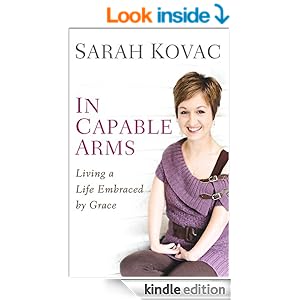
Review: In Capable Arms by Sarah Kovac


In Capable Arms
by Sarah Kovac

I generally don't like Christian non-fiction. I find much of it dishonest or preachy...especially autobiographical books.

But In Capable Arms is an incredibly pleasant exception.

This is the bio of Sarah Kovac who was born with arthrogryposis, a condition that occurs in about one in every 3000 births where the arms are pretty much useless.

Kovac tells about her experiences growing up and coming to terms physically, culturally, emotionally, and theologically with this disability. She writes about the shame and fear she went through and continues to go through. As this is a book written by a Christian, she also writes about her faith and about the theological, doctrinal issues and platitudes she went through

It is also a story about family, about marriage, and motherhood. The writer's depiction of her parents' parenting philosophy, her own fears of being a capable mother, and her journey to self-acceptance will touch anyone even if the reader does not have a disability.

This book is recommended for everyone, disabled or not, who have had to battle to gain self-acceptance or who has had struggles which make them feel "abnormal." The writer is insightful and shows the philosophical and emotional pitfalls that those with any kind of life struggle might fall into.   There are little insets with questions that the reader may journal about. These attempts at interacting with the reader seemed slightly intrusive and a perfunctory attempt to a kind of self-help book for Christian women's group. The journal questions really don't quite work. Either they should not have been included or they editors should have prepared more questions, surveys, reading guide, or commentaries.

However, the inclusion of some kind of reading guide is habitual with some Christian non-fiction. Some readers will like the inclusion and may find the journal questions useful.  Recommended.

Thursday, August 28, 2014

Review: The Martian by Andy Weir

The Martian, by Andy Weir


Andy Weir has managed to create an exciting book about numbers. The Martian is a fun book. It’s a quirky book with an engaging main character, but it is not a perfect book.


Its perfection lies in the fact that the main character is as much an alien to the reader as he is to the world he finds himself in. He is an earther stuck on an inhospitable planet where he faces starvation, death by cold, death by thirst if he is not rescued. But he is also an alien -- a martian if you will-- because unlike the rest of us Earthers, he is an astronaut. Astronauts are not made like you and me. They are constantly heroic, they don’t allow fear to oppress them, they know stuff.


Our hero is in danger, but there is absolutely no doubt in the reader’s mind that he will save himself and stay alive until he is rescued. In that respect, the bus has no tension. And yet tension is everywhere because the hero Mark Watney is constantly on his toes and constantly having to muddle through botanical, mathematical, engineering experiments. This is where the fun comes in. The Martian feels like a survival manual. It feels like nonfiction. The reader is constantly being taught about space, chemistry, physics, and botany. But it doesn’t feel as if one is being taught. One is simply being pulled along breathlessly in the wake of a kind of superman whom one cannot identify with but whom one likes because he has good humor and seems like a humble but smart guy.  


But as I said, the book has problems.


The problems are mostly in the sections that are told in the third person. It is here where the author shows that he has much to learn about writing scenes, descriptions, and real characters. The third person narration didn’t add much to the book  and only shows the shortcomings of the author. All that said, I recommend this book highly if you are a math geek and if math doesn’t give you a headache.


This is a short review. A larger review of this book will be up at THE FAN in August 2014
http://www.fantasticstoriesoftheimagination.com/current-issue/fan/

Sunday, August 24, 2014

Review: NIV Spiritual Renewal Study Bible

I really love this Bible.. well there is my usual caveat: I like the NIV but I love the NLT. But you know...other than that....

The basic subtext of the commentary in this Study Bible is Restoration. One executive editor is  David Stoop, a psychologist and founder of New Life Ministries, which offer counseling and treatment across America. The other executive editor is Stephen Arterburn, who has a masters n Education. So there is this pervasive idea that the person reading this study Bible has been through a hard time --perhaps even endured some destruction in her life-- and is ready to rebuild her life, her relationship with God, and to allow God to lovingly rebuild her.

I know that all sounds like pychobabble but that's just me. The commentaries profiles, etc do not sound like psychotherapy. They really do feel spiritual. And trust me, I have a real dislike for anything that hints, sniffs, reeks of psychobabble...probaby because I've often found Christian psychologists to be more psychological than Christian. But that's just me. Perhaps.

Unlike the Spirit-filled Bible which has a lot of names I recognized, the writers and editorial staff of this book are unknown to me. (That's not saying much, of course. . .but it goes to show that a great Bible study doesn't have to be written by folks who are famous in Christendom.)

The Study Bible begins ith a User's Guide which discusses how to examine our lives. It's a short little feature but that alone is something every christian should read.

Then a list of features follow:

The features in this Bible are similar in many ways to those found in other Bibles but there are also some differences.

There is the usual Bible Book Introductions, Text Notes, Devotional Reading Plan, Spiritual disciplines devotionals, spiritual discilplines profiles, and Character Profiles. But difference here is the focus on spiritual discipline as a means of renewal and restoration.

Each Bible Introduction includes: The Big Picture (a synopsis of the Bibe book), Spiritual renewal themes found in the particular book (for instance, the spiritual renewal themes in Genesis are A Good Creation, A Ruined World, Promises of Redemption, and Hope for Reconciliation.)

The Spiritual Keys Devotionals,  Devotional Reading Plan, spiritual discilplines profiles, and Character Profiles are all interspersed throughout each book and each chapter also contains insightful notes for Bible verses at the bottom of the page.  Indexes to all these are included in the back of the Bible.

The index to text notes include such psychological terms as boundaries, commitments, communication, complacency, peer pressure, compromise, choicesdenial, rationalization, discouragement, self-esteem, blame, accountability, wholeness, inventory.

There are seven keys -- the ones found in the beginning introduction:
1) Seek God and Surrender to him
2) See the truth
3) Speak the truth
4) Accept responsibility
5) Grieve, forgive, and let go
6) Transform your life
7) Preserve Spiritual Gains

All these have subtopics and verses that apply.

Seriously, this remedies the biggest flaw of the Celebrate Recovery study Bible which felt as if all we got was a litany of blaming former victims. I mean I understood the sorrows of the folks in celebrate recovery but the book felt a bit constrained by the whole recovery terminology. (But i digress.)

The Bible Characters in the character profiles are the usual folks...but given that renewal spin.  I really liked the one about Herod's Family and greed.

The spiritual disciplines, devotionals, and profiles show the disciplines as:
Bible study and Meditation, Fasting, Prayer, Repentance and confession, Service, Silence, Solitude, Spiritual Friendship, Stewardship, Worship.  All these also have subtopics. For instance the spiritual friendship subtopics include "But isn't God enough?" "Friends for life." "Maintaining our relationships" "Touching heart, soul, and body" and "Marriage: A most intimate friendship."

I heartily recommend this book. I received this book from Zondervan at no cost for a fair and honest review.


Monday, August 18, 2014

Review: Dark Eden by Chris Beckett


Dark Eden
Chris Beckett


  • Hardcover: 400 pages
  • Publisher: Corvus (January 1, 2012)
  • Language: English
  • ISBN-10: 1848874634
  • ISBN-13: 978-1848874633


  • Wow, this is a great book! I've always loved anthropological scifi, where we see the power of culture on human affairs. I also like speculative fiction where a writer comes up with a speculation...a kind of "What if?" and then we get to see the ramifications of all those "what ifs."  Part of the fun of what if stories is being aware of how the smallest thing affects or is affected by that great what if proposition.

  • So then, imagine an Adam and Eve couple, stranded on a dark planet with no sea and no sun. They decide to have children and they have told these children about the world they came from. These tellings are passed on through subsequent (often mutated because they are inbred) generations. How is a spaceship to be described?  Why it's a boat in the starry swirl sea above!    

  • This what if speculation of the novel comes very close to being a parable and some folks might fnd themselves being uncomfortable with that. What is this book saying about Oral Tradition? (and in a subtle way, about the gospels, since the gospels --according to some-- were oral traditions?) And what is the mix of truth and misunderstanding? What is the purpose of story? To inspire? To change? To lock us into tradition? What if the story has elements of conservatism and revolution in them? What to choose? When do you revolt against Elders? When do you listen to them? Should you stay in a static place awaiting rescue from the sky or should you move on from the old doctrine, so to speak?

  • Other readers might find the book hard going because there is a whole lot of talk about "slipping with" folks. Morals are different in a world without talk of God and where the idea of Jesus has disintegrated as the King of the Juice. (We get the feeling that either Angela wasn't too bright or the tales she told got diuted over the years.)  I'll also add that "juice" is the word for semen in this book.

  • Well, there are a lot of words for stuff in this word. The author is new at coining words, and of course one has to read this story intuitively in order to feel what a certain word might mean. It's not that book is meant to be a puzzle but you'll have to muddle through a bit and sometimes you might not fully understand what a "leopard" looks like or what trees on Dark Eden actually look like.

  •  Since this is full-on speculative, I can't say the writer set out to challenge the Garden of Eden Biblical narrative. There is only one line there which seemed to be a dig at religion. But there is a feel in the novel ...a kind of arrogance toward old stories, and the author does seem somewhat proud of himself as if he has shown his readers that he is an honest seeker after truth who has struggled with accepting anything by faith and he understands their quandary. In that way, certain parts of the story feels downright smug and other parts feels wrong. If a person of faith had written a story with the same premise, that person might have included a god or might have had more insightful things to say about the idea of traditional storytelling. But then the believer would have a different purpose. I also think that a modern Christian writer would probably not have created such a culture. Christian writers are notably dishonest and prudish about sexuality and there probably would have been some dishonesty in exploring the sexual culture of the descendants of Angela and Tommy.   

  • And yet, the ramifications of the story works out so well in so many fine and wonderful details that one can't be too angry. Atheists will use it to show how wise they are in their opinions. Some might even use this book to mock religious people. But I don't think this is what the author fully intends. This is the beginning of a series so who knows where the author will go with it? Does he intend to mirror other events in human history and Biblical history? We already have the makings of tribes and as the book ends, there are hints of tribal warfare coming in FAMILY. As such, we can't make any decisions about the author's feelings about faith in a god or gods of anykind. Not until he makes the people of this world "make" a god or if a god presents himself to the people of Eden. At present there are moments in the narrative when some great coincidence happens and one finds one's self asking why. Why has hero John Redlantern found this relic? Why did the adventurous group from FAMILY find what they found? Is it just by chance? Is it providential guidance from a god or from the universa God? Is it just a writer doing the easy stuff and creating coincidences in the plot?  We shall see.

    All in all, this is an amazing book.

    I'll be writing a longer review for this on The Fan sometime in September. Til then....
    I received this book through the blogging for books website. 

    Friday, August 08, 2014

    Review: The Quick-Start Guide to the Whole Bible

    Review: The Quick-Start Guide to the Whole Bible
    Dr William H Marty
    Dr Boyd Seevers
    Bethany House
    $12.99
    ISBN: 978-0-7642-1128-7


    The Quick-Start Guide to the Whole Bible is a good book for Christians who need to understand the timeline, summary, and spiritual significance of the books of the Bible. It is a good starting place for Christians who wants to get a basic idea of each Bible book before reading it. That means the entire Book of Psalms or the book of Isaiah are distilled into four succinct pages. The writing is accessible and informative. 

    Sometimes, one finds one's self wondering why a particular book was written in the first place. Especially when for the price of this book, one could get a book which gives much more indepth commentary ..or even buy a good used printed study Bible from Ebay or a new study Bible on kindle.

    How shall I describe this book? Well, it's somewhat useful for those who have never read their Bibles or for people who know Bible verses but who really don't know why or when each Bible prophet wrote his book. Think of it as the Cliff Notes edition of the Bible, although Cliff Notes would probably be more indepth. 

    There is another book, published a few years ago, called:
    The Whole Bible Story: Everything That Happens in the Bible in Plain English by Dr. William H. Marty
    Yep! The same author. I really liked that book. This book looks like the outline for that book. So... I ask again: why was this version needed?  Did someone say an even smaller summary of the Bible was needed? 

    The authors should have given their manuscript to folks who know nothing about the Bible. Why do I say this? Bevause sometimes the belabor seemingly unimportant points and ignore important points. When they belabor an unimportant point, the knowledgeable Bible reader finds herself feeling she has subtly been indoctrinated into some picayune pet authorial doctrine. For instance, in Genesis, they go out of their way twice to mention the Sethite theory and to declare that no one is sure who "the sons of God" is. (This seems to be done to make the reader aware of the Sethite doctrine.) Yet, earlier in the Genesis chapter, the authors don't comment on what the meaning of the "serpent" might be. If ever there was a place which needed a comment about what folks not "knowing" or agreeing on an interpretation, shouldn't this be it? No, really! Serioiusly! It's not as if I want the author to jump around from book to book, but if they said something to the effect of: "the book of Revelation defines this serpent as Satan" then I'd be cool.

    And speaking of the Book of Revelation, the authors repeatedly say that the book was written by John. Well, yes, the book is written by John but John also says it is also a revelation given by Jesus. And John was directly told what to write to the seven churches. Instead, the authors say that John describes Jesus as being the source and subject of the book of Revelation. A comment which felt kind of mealy-mouthed to me. If the authors wanted to be fair, they could have said that "some people -- not us, mind you-- believe that these were actual visions. But we feel that John was consciously using apocalyptical metaphor."  I understand that authors need to cover their butts in case they offend testy argumentative Christians but I wish this book had been more honest about what the authors actually believed. Instead, we get a feeling of authors putting themselves in a safety-zone in order to have a book that is the lowest common denominator among denominations. Of course writing a book about the Bible...well, you're damned if you do and damned if you don't. We Christians are pretty argumentative. Still, for all their generalize summary of the Bible books, one does get a strange feeling that one is being treated to a party line.

    Call me a cynic but I tend to think that many Christian authors of big publishing companies try to keep themselves safe. They write about the same 600 or so topics.  Christian publishing houses just like selling books. Christian authors don't seem to really care about writing better than their competitors. They just imitate each other. I can imagine the editorial meeting for this book: "Let's put 'Quick-Start Guide' in the title. Folks like the words 'guide' and 'quick-start' and will buy our book. And this book will really help those folks who don't want to read the Bible."  

    There is nothing reallly bad about this book. It could certainly help a lot of people. But there really isn't anything all that great about it either. There are countless other books that seek to encapsulate the Bible and who do a better job. Heck, one can go on the internet and find used study Bibles that are more helpful... and those study Bibles INCLUDE an actual Bible.  

    If you can afford to, and if you really hate reading the Bible and want to pretend you have, I'd suggest getting Dr Marty's other book. Or David Pawson's Unlocking the Bible. It's a little bit more expensive and it is kind of heavy to carry around but it's much more helpful than this one is. The chapters describing each Bible book are like introductory sections in a Study Bible. One leaves the book feeling dissatisfied...and vaguely looked-down upon. 

    Monday, July 21, 2014

    Review: NIV God's Word for Gardener's Bible


    Review: NIV God's Word for Gardener's Bible
    edited by Shelley Cramm, General Editor

    And who is Shelley Cramm, you might ask? I don't know who she is. If she is popular in Christian circles, I'm unaware of that. Maybe she's popular in gardening, horticulture, and landscape cultures. Funny thing, though: Although she is a total unknown -- at least to me-- this is one of the best study Bible's I've read. I'm really digging it. (I m so tempted to put in a lot of plant puns in this review.)

    I thought this Bible study would be sort of homespun and cutesy. It's not. It has some great devotionals, though. Devotionals that touch the soul but which are also incredibly informative. I probably will not look at figs the same way, after the section on the significance of the fig tree in the garden of Eden.

    Gardeners who read their Bible are probably already aware of the significants of pests, droughts, watering, planting, pruning, etc. I'm sure gardeners see the Bible through gardeners' eyes, just as scifi writers see the Bible as a book by a creator about worldbuilding, or lawyers see the Bible in terms of legal documents. But do most gardeners know about the plants in the Gardens in Persia?

    There are some wonderful insights in this book and some great devotionals. One of my favorite is the discussion of Xerxes going into the garden after Esther had revealed Haman's plot to him. It hadn't occurred to me to see the situation as symbolic of going into one's place of repose to ponder bad news. Yes, I thought as I read the devotional, this rings spiritually true.

    The book contains 260 daily readings and 52 weekend readings all arranged in weekly themes. One cannot go a few pages in this Bible without seeing these devotionals. The weekly themes are divided into sections which include Garden Tour, Garden Work, Garden Stories. These sections are further subdivided. For instance, Garden stories include devotionals on Seasons, Sun and Shade, Weather, Pest and pestlence, Jesus' Parables, Israel's horticultural allegories, Away from the Last Supper, Jesus, the Seed, the Root, Branch, and Firstfruit, Harvest of Righteousness, Intimacy with God in the Garden. All these readings are scattered (sowed) throughout the Bible but there is a guide to all of them collected in the Introduction.

    Each devotional contains a verse to meditate on, a passage to read, and other Biblical passages with which to compare to the original verse. The devotional follows, which may or may not include quotes from gardening books, and historical and hortological backgrounds. The devotional ends with a prayer. Then a short sentence directs the reader to other devotions in that particular category.

    One of the best parts of this study Bible is how the editor shows the thematic flow of certain plants. The fig leaf in the Garden of Eden pops up in the Genesis section. Later, the cursed fig tree closes the metaphor. The meaning and purpose of the olive leaf in the dove's mouth as a symbolic truth to Noah on through to the Mount of Olives. The lentils Esau ate in exchange for his birthright, through the rape of Tamar to Ezekiel's bread to Daniels pulses. Rahab's use of flax and the Proverb 31 woman's use of flax. And now I certainly understand why the prophetess Deborah would sit under a palm tree.  After reading through this Bible I'm tempted to wade through and meditate on all the floral images and spiritual essences that are hinted at in the Song of Solomon.  

    The book is hardcover and feels sturdy. It's thicker and smaller than the other Bible studies I've been reading, which makes it handy for one's church bag. The print is normal-sized. I would've liked a large print but that might be asking too much. The translation is the NIV. I highly recommend this book to all Bible readers but especially to folks who love gardening.

    I received this book free in exchange for a fair and honest review


    Sunday, July 13, 2014

    Review: Celebrate Recovery Bible


    Okay, I shouldn't feel so angry. After all, the HarperCollins folks didn't exactly say the Celebrate Recovery Bible was a Study Bible. So..my bad for assuming it was...because the Celebrate Recovery Bible is kind of. . .lacking.

    It might be me. I've been reading and reviewing a lot of Bibles lately. And when I see the amount of work put into Bibles such as the NIVintegrated Bible or the Spirit Filled Bible or the Modern Life Study Bible...it just makes the Celebrate Recovery Bible look pale in comparison.

    First of all: what it has:

    There are some great testimonies from Christians who have had addiction, abuse issues. Those testimonies are pretty brave because we allknow how judgemental some Christians can be. OR how self-reliant. So kudos for these folks who put their stories out there for readers to identify with.

    The Celebrate Recovery Bible also has Bible character studies. For instance. I am Eve. And you can imagine what insights can be drawn from the whole Eve, temptation, and forbidden fruit thing. There are also other characters such as Moses, the Demoniac, the Syro-Phonician woman (whose daughter was oppressed by demons...or as some would say addictions. The mother is shown as the archetypal suffering parent of a child who should be in recovery.)

    Like all Bibles, it has Book Introductions, Lesson Studies, Recovery-Related Scripture Ties, Topical Index, Daily Devotionals, Subject Index, the Eight Principles and Twelve Christ-Centered Steps of the Celebrate Recovery Program.

    The Celebrate Recovery Bible has a foreward by Rick Warren and is a "purpose-driven recovery resource with devotions and articles by John Baker." It is designed for Christians in Recovery. The Twelve Step groups such as AA, Alanon, OA, NA, etc began as Christian organizations. However now they have become places where figuratively one's Higher Power could be a chair or a rock. This book seeks to return the twelve steps to its moorings and to show the Bible verses that are behind those "Christ-centered steps."

    A good goal, I think. So I really can't fault the Bible. Except I was kinda expecting more.  The way the Bible uses the Scripture "ties" seems a bit facile and the commentary about some of the Bible characters seems a bit old hat and sometimes forced into the recovery motif. For instance, Martha of Mary/Martha/Lazarus fame is depicted in a way in which the Bible never depicted her. In the Bible we get a snapshot of her reaction on a particular day, a particularly busy day. Jesus says nothing about her recovery "issues" and Martha is shown in the Bible as being very spiritual but somewhat harried about having new guests suddenly show up at her house: cultural hospitality issues and requirements of women etc. But in this the character study says Martha is "spiritually-barren," "a people-pleaser," someone who wanted to "impress people"  whose "self-identity revolved around identity." Really????? Jesus is depicted as "confronting Martha's non-productive habits and emotions." Seriously?

    I'm all for folks getting insights that suit and touch their lives but sometimes I had to roll my eyes because of the over-reaching. But there is also a part of me that thinks they could have been more involved in all the Bible verses than they are. They really don't comment on the Bible chapters, books, stories, etc as much as they c ould have. And they hit all the typical Biblical stories, which gives me the feeling that these folks don't read their Bibles themselves. They just work with Bible stories they know.

    So a part of me thinks they should've really been more in-depth with the Bible study...and another part of me feels "heck, I'm glad they didn't do to other Biblical passages what they did to the Martha section."

    I guess I can recommend this Bible. It will no doubt bless many people. And it does tie-in the Scriptures to the twelve steps. But it wasn't particularly impressive as a study Bible.  

    I got this book as part of the Harper Collins booklookblogger review program

    Monday, July 07, 2014

    Review: A Floating Life

    Floating Life
    Tad Crawford
    ISBN: 978-1611457025


    Tad Crawford’s A Floating Life is ostensibly fiction. The nameless narrator is adrift, not knowing where he is, where he will end up, and why he finds himself in disparate places. As fiction, the plot revolves around his confusion about his sudden dislocations, the breakup of his marriage, and his new job as assistant to someone who is trying to harness the energy of the waves.

    But that is only important if one accepts the story as fiction. The story, however, is not fiction. It is not even surreal fiction, although the situations that happen to our narrator are all quite dreamlike. Rather, this book is almost like a literary rift on change, fluidity, and confusion. The thematic question is: “What is change? What is energy? How do we drift with life? How do we control our drifting? And will our hero learn to change and to accept change, come what may?”

    The book is philosophical, speculative psychology. Therefore those who buy this book expecting anything like a story will be very disappointed. But those who like books that symbolically explore the human psyche will find this book very beautiful, odd, fantastical and profound as it rifts on existence, change, goals, and cosmic and human energy. Those who like Jonathon Livingston Seagull and Carlos Castenada might like this. Some of the images used by Crawford will lodge in and haunt the psyche for a long while.        

    Monday, June 30, 2014

    Review: New Spirit-Filled Life Bible


    The NIV New Spirit-Flled Life Bible is a great Bible for Charismatic and Pentecostal Christians. The Executve Editor is Jack W Hayford, Litt.D. and anyone who has heard Dr Hayford teach will understand how profound his insights are. Other editors are Paul G Chappell, Ph.D., Kenneth C Ulmer, Ph.D, D.Min., Judy Brown, Ed.D., Roy Hayden, Ph.D., Jonathan David Huntzinger, Ph.D., and Gary Matsdorf, M.A.

    Other Contributors are people well known in Charismatic circles, including people such as Reinhard Bonnke, D.D., Paul F. Crouch, Billy Joe Daughterty, Marilyn Hickey, Frederick Price, Pat Robertson, James Robison, among many others lesser-known but just as influential.

    The Book contains several sections, one of whch covers forty-one themes known as "Kingdom Dynamics." The kingdom dynamics are essential to those who believe in the pentecostal message of the full gospel and the good news of the kingdom. Because this study Bible seeks to highlight the past and present works of God's Holy Spirit, it is quite different from Bibles which may have more preterist leanings.  In order to show the timeless workings of the Holy Spirit, the editors have used a dove symbol whenever a Biblical text connects to the Holy Spirit.

    The Kingdom Dynamics themes include Prayer Power Precepts, Spiritual Empowerment Precepts, Personal Growth Precepts, Supernatural Ministry Precepts, Global Outreach Precepts, among others. These precept sections contain essays and sermons on topis and specific Bible verses.

    There is also a word wealth section which shows the meanings of certain important words. So if one is lookin gup the meaning of grace or forgveness, one can find them easily.

    Then comes the Truth-In-Action sections whch are charts that show what each Bible book teaches. The end sections of the Truth-In Action connects to the Word Wealth found in the books and to Kingdom Dynamics. There are also charts and in-text maps.

    Each of the Bible books begins with a description of the Author, the date the book was written, the theme of the book and the key words of the book. Then the Author's history, the Date, the content, the personal Application, Prophesies about Christ,, description of the Holy Spirit, and Outline of each Bible book is given.  There are charts that show a Bridging of the Testaments and which harmonize the gospels. After the book of Jude, there are studies which prepare the reader for the Book of Revelation, showing all the possible views of the Last Days.  (It doesn't take any particular view, leaving the decisions to each individual Christian.) After the Book of Revelation, there are articles on the Holy Spirit Gifts and Power, and The Holy Spirit and Restoration, World Evangelism, Ministering Healing to the Nations, Understanding Messianic Jewish Ministry, How to Lead a Person to the Savior, and a Concordance.

    Throughout, there are clickable Bible verses for almost every verse in the Bible which gives geographical, theological, cultural, and other information.

    As I said, links are aplenty. I don't know how the printed version of this study Bible would look but I definitely want one.  I generally don't use kindle versions of Bibles because I get lost with all that skipping around then backtracking to get back to the Biblical text.  The way the kindle s set up...it's possibe that one can read all the notes on the Biblical text without reading the texts themselves. And unless you are good at using kindle, I suggest you read the How to Uee This Bible section and links. If you can, I'd suggest getting the printed version.

    This is a very good Bible and I highly recommend it.


    Thursday, June 19, 2014

    Review: The Book of Job: A Biography


    The University of Princeton Press has a provocative series entitled, Lives of Great Religious Books. This series studies the creation, history, interaction, and influence of revered religious books throughout the ages.

    One new entry into the series is Mark Larrimore's The Book of Job. Larrimore's book is not only a history of Job but a study of the history of human philosophy about suffering and God's involvement in human suffering. The problem of  suffering presented in Job, are these: Can the reason behind a particular person's suffering be fully known to any but God? Can it be fully understood by human reasoning? Is one human being's suffering innately incomprehensible to other humans? Is God behind human suffering? Does God have to explain himself to the sufferer (and if He did would the sufferer understand the wisdom of an almighty otherworldy inscrutable (and personal) God? Job is at its essence a book about interpreting pain and about discourses on understanding the mind of God.

    Larrimore begins his book with a brief introduction which begins somewhat academically while it quickly traces the problem of Job. The introduction ends surprisingly with a very elegant heartfelt commentary on friendship and on how the book posits its readers. Such an introduction happily prepares the reader for the writer's academic skill as well as the writer's heart.

    Larrimore goes on to show how mistranslations, lack of knowledge of Hebrew, lost or wrongly-placed passages, the translator's choice of words, emotional state, ethical temperaent, misconceptions about the idea of "patience," the interpreter's acquaintance (or lack thereof) with grief and suffering, and a saccharine idea of Job have affected the book's history.

    He begins this by discussing the apocryphal "Testament of Job," a book which in effect smooths out the rough places and makes all of Job's suffering palatable by explaining everything that could be challenging to the righteous mind's conception of God and God's goodness to His followers. The portions and summary of Testament of Job which Larrimore excerpts sound like a fairytale, which the Book of Job (which the western Bible has) decidely is not.

    Larrimore includes rabbinical discourse and --later on-- Christian religious (of the major denominations) about the Book of Job. In addition, he shows how Christian secular (Chaucer) and not-so secular (Voltaire and the enlightenment, Rene Girard, Elie Weisel, and David Rosenberg have attempted to decipher and understand the mind, heart, and artifice behind the book of Job.

    In the end, Larrimore states:
    "Keeping company with Job, as friend or interpreter, is a worthy activity. Only the one who sees no challenge in Job or the questions his book is thought to raise should be dismissed. Recognizing that Job's questions are not only 'unfinalized' in the book of Job, but 'unfinalizable', we may conclude that our obligation is to keep the retelling going in all its difficulty."
    The Book of Job: A Biography is highly recommended.


    Monday, June 16, 2014

    Review: NIV Integrated Study Bible


    NIV Integrated Study Bible: A New Chronological Approach For Exploring Scripture
    John R. Kohlenberger III, editor
    ISBN: 978-0-310-41103-1


    The NIV Integrated Study Bible -- called NIVISB for the rest of this review-- is a Bible in which all the Bible books are chronologically interwoven (or placed parallel to each other) to form a book that smoothly follows the Bible’s historical timeline. Am loving it and I’ll say that the logistics of organizing this study Bible must’ve required a great deal of planning.

    The navigation of the NIVISB starts out fairly easy with the Book of Genesis. At first, it seems like a normal Bible. But then the portions of the genealogies in I Chronicles and of the genealogy of Jesus Christ, (from the gospels) pop up around the Genesis 5 and Genesis 10. Then the reader finally understands how the Bible works.

    The learning curve is intuitive. So after a while, the books sudden frequent divisions into one, two, three, or four columns is totally understandable. As the study Bible continues and we encounter other Bible books, more weaving occurs. The Book of Job, for instance, is placed between Genesis and Exodus. When one reaches the historical books --especially I & II Samuel, I & II Kings, and I & II Chronicles-- the prophetical books, the wisdom books, and the book of Psalms are all interwoven throughout. One gets to see how the prophets interlap, what kings they were prophesying to, and where and when they prophesied. In the New Testament, all the epistles are intermixed with the Book of Acts.

    I’ve often found Bible studies with a lot of commentary to be very intrusive. And this Bible study is the least intrusive study Bible i've seen in ages. There is very little commentary. A map or chart here or there at the beginning of certain sections, but no theological discussions. I really like this because although commentary helps further understanding sometimes commentary can be confused with real Bible truth simply because it is placed in a study Bible. Commentary can be too influential and often opens the mind as well as closes it. This is not to say that this arrangement of the books doesn’t have subtle influences, but at least the opinions are less in your face and are at a minimum.

    The NIVISB is divided into general sections which deal with specific time periods: The Creation Through the Patriarchs, Exodus to the Conquest, Conquest through United Kingdom, Divided Kingdom and Exile, Return to the Land, The Life of Jesus, The Early Church.

    The way the Bible books are interwoven in the NIVISB saves a lot of cross-referencing. It definitely places every book in historical context. Of course, all the books of the Bible were written by different individuals --each with their own writing styles and focuses-- so there are moments when there are jumps in writing styles.  But if one accepts that all of Scripture was written primarily by the Holy Spirit, one can accept the apparent discontinuity in human styles. In order to read this Bible, the reader has to make a conscious mental change to allow the book to be what it wishes to be. And the blessing of this Bible is that when folks read it they will understand the history better.

    If I have to complain about something, here are a few: The first is that it isn’t in Large Print. The second is that unlike other Study Bibles, the NIVISB is not a standalone Study Bible. You will need a regular standard Bible to use alongside with this one because the Bible books are all cut, copied, and transferred to different positions. This means that because the continuity of each Bible book is broken, the NIVISB  really cannot be used to study any singular Bible book. If one wants to study the book of Judges, one has to find its scattered chapters and put them back in the accustomed chapter order used in regular Bibles. The last complaint is more of a nit. At the bottom of the Bible pages is a timeline from Abraham to Malachi. An indicator shows where the present Bible book fits in. I guess it works, but I keep thinking the timeline could’ve been used in a better way.    

    Monday, June 09, 2014

    Book Review: Angels, Miracles, and Heavenly Encounters by James Stuart Bell


    Christian publishing Veteran, James Stuart Bell, has compiled a new book, Angels, Miracles, and Heavenly Encounters, about supernatural events that happen in the lives of Christians. These events, which range from healings, to visions, to divine protection, to angelic intervention, might seem extraordinary to many but are quite commonplace among Christians, and Christians -- like Mary-- often treasure these instances when the veil is removed and the numinous and the holy enters their lives with its sweetness, health, and power.

    These forty-four first-person stories of the marvelous wonders of God will strengthen the faith of Christians and encourage those who have not seen God or who have not experienced any supernatural events opening their minds to the possibility that the God of Miracles is very much at work in the lives of believers today.

    Some of the testimonies, such as "Hear No Evil" concern protection -- even when the person being protected is unaware of it. Some tell of comfort, as in Pam Zollman's "A Secret for Five" in which a woman on the verge of a divorce receives prayer and "a word of knowledge" from a stranger who seemed to know everything about her life. Some, like Kristin H. Carden's "Beyond the Fear of Death" are about near-death or after-death experiences. Some are accounts of miraculous provision, such as Beverly LaHote Schwind's "The Lasagna Multiplication Miracle." Some are of seeing spirits --known or unknown. Whether divinely helped or being the divine helper, as in Suzan Klassen's "A Shield from Danger," these Christians found themselves in a holy connection between heaven and earth.

    The book is a quick and easy read and also a good addition to any library. There are a few caveats, however. The first is merely nit-picking, the second is more substantial. First, the nit-picking: Many of these stories are ghostwritten -- in a kind of Christian writing style that Christians are used to-- and it gives the testimonies a bland Christian magazine uniformity. True, most people are not writers and testimonies probably need to be edited as all writings need to be edited, but the sameness and the writerliness of these testimonies make the stories lack distinct personality.

    The second caveat, which is vastly more important, is the interpretation often laid upon the spiritual encounter. Most Christian testimonies have a moral at the end, so interpretations of a divine incident is necessary, and for the most part, the "take-away" interpretations of these supernatural events are Christian. But some are not. The interpretations are "spiritualized" but somewhat unBiblical. In the Bible, Christians are warned to judge all supernatural events, to test the spirits whether they are of God or not.  Most Christians, for instance, would be wary of assuming a spirit is a dead relative and would need true discernment to ascertain whether a spirit presenting as "Mom" is really Mom or just a demon posing as Mom. Therefore, even when a book purports to be written about God, a Christian should read the book with discernment.
    The first story that was problematical was "Seeing Things in a Different Light" by Tina Samples. In it she relates how her Uncle Kenneth returned from war with blindness. However, after the church prayed, his sight was miraculously restored. . .for one day. Thereafter Uncle Kenneth was blind for the rest of his life.

    Samples interprets this as God healing Uncle Kenneth as "a gift -- a celebration of life-- and a reminder that God is still gracious even when we experience devastations." She goes on to write that Uncle Kenneth learned to see all things in a different light-- even God." Perhaps this interpretation is true-- it is certainly beautiful and spiritual sounding-- but it flies in the face of Scriptures that tell believers how to get and retain a healing.

    Verses such as:
    When the unclean spirit is gone out of a man, he walketh through dry places, seeking rest, and findeth none. Then he saith, I will return into my house from whence I came out; and when he is come, he findeth it empty, swept, and garnished. Then goeth he, and taketh with himself seven other spirits more wicked than himself, and they enter in and dwell there: and the last state of that man is worse than the first.  Matthew 12:43-45
    Or Scriptures that speak of how faith and healing can be stolen by the faithlessness of others. Verses such as:
    Take heed therefore how ye hear: for whosoever hath, to him shall be given; and whosoever hath not, from him shall be taken even that which he seemeth to have. Luke 8:18
    Or the healing of the Blind Man near Bethsaida, a city Jesus cursed because of the unbelieving hearts of its inhabitants.
    And he (Jesus) cometh to Bethsaida; and they bring a blind man unto him, and besought him to touch him. And he took the blind man by the hand, and led him out of the town; and when he had spit on his eyes, and put his hands upon him, he asked him if he saw ought. And he looked up, and said, I see men as trees, walking. After that he put his hands again upon his eyes, and made him look up: and he was restored, and saw every man clearly. And he sent him away to his house, saying, Neither go into the town, nor tell it to any in the town. Mark 8:22-26
    or various admonitions about "holding tightly to what one has", or "resisting the devil."

    The testimony and its interpretation might be part of a beloved family tradition but beloved family traditions, however close to the heart, should be challenged sometimes. Although interpretations of personal spiritual encounters are "between a person and his God," it is quite possible that the result of a spiritual encounter is not what God desired at all, and that Uncle Kenneth's family and church created a pretty theology out of a failure because they did not fully understand what had happened. It's possible someone at the family celebration planted a seed of unbelief (a wonderful beautiful theology of unbelief) that affected Uncle Kenneth's healing. It is possible that the church brought about Uncle Kenneth's healing but failed to teach Uncle Kenneth how to hold and retain his healing. The Bible declares the devil comes to steal, to kill, and to destroy and that God is light and God does all things well, but the testimony here challenges that -- in a spiritual way of course.

    Another testimony which was problematic was the near death experience related by Ingrid Shelton, "The Tall Visitor."  The author declares a spirit, probably a spirit of death, came to retrieve her for her journey to the author life, but a voice told the spirit to take another boy and to leave Ingrid to live. Toward the end of the testimony, however, the author writes, "Yet from the day the death angel had bent my upper body to the ground, I began to develop scoliosis. Was it to be a reminder of my encounter with spiritual forces? I wondered."

    Questionable. True, Jacob had a limp for the rest of his life after his encounter with the angel. But to use this Biblical story to show God as the creator of illness is somewhat akin to the devil using Psalm 91 to tempt Jesus to throw himself off the top of the temple. It is possible the angel of death was not from God. It is also possible the angel of death was from God but the devil used the opportunity to create illness, especially if someone nearby made a "spiritual" comment about the incident. It is possible the medications in the hospital affected an already weakened area of Shelton's body.

    The compiler/editor should have added an insightful introduction which explored and discussed the many possible facets of a Christian's encounter with the supernatural. However, it is a common trait among many Christian editors to do simple compilations without adding a theological discussion at the end or beginning of the book.

    This book is recommended because it shows the world a living God who still does miracles and it shows the supernatural nature of the world. However, the following advice from Jesus should be heeded because while some of the testimonies in this book will add to one's faith, other testimonies might plant spiritual seeds which depict God as the unpredictable cause of sickness or as a trickster who destroys aspects of a person's health to make them more spiritual.
    Take heed therefore how ye hear: for whosoever hath, to him shall be given; and whosoever hath not, from him shall be taken even that which he seemeth to have. Luke 8:18


    Wednesday, May 28, 2014

    Review: Deliver Us From Evil by Don Basham


    Deliver Us From Evil: A Pastor’s Reluctant Encounter with the Powers of Darkness
    by Don Basham
    Chosen Books
    US $14.99
    ISBN: 978-0-8007-9603-7

    Deliver Us From Evil is one of the few first person-memoir modern religious books I like. Really like. It’s about a pastor’s slow and yes very reluctant journey toward understanding that there are demons in the world and that those demons are very actively destroying the lives of believers and non-believers alike.

    Fact is, most modern western Christians don’t take the devil seriously and back in 1960 when Pastor Basham’s journey began...very pastors bothered to even ponder the demonic. Belief in the supernatural had been knocked out of them by Christian seminaries and by the culture they lived in; demons were assigned to the Middle Ages and Jesus was thought to be “humoring” the people of His age whenever He mentioned Satan.

    But Pastor Basham ended up taking an unplanned journey and many real-life lessons into deliverance, and this book shows the small personal steps and theological advances he took to understand how demons operate.

    Basham is not arrogant and doesn’t put himself out as an expert. The book is about spiritual truths but it is also a memoir of his life as a pastor and a mirror of the trials that happen to ministers along the way.

    In addition to stories of afflicted formerly-demonized people, Basham also shares what he has discovered about how and why demons affect people and how to battle them. The stories are compelling and the people he describes -- demonized victims, theological opponents, congregations, and colleagues-- all seem like people we know and have met.

    Of course the book is a handbook as well. So those who read it will be well-armed in the spiritual warfare battle. Highly recommended.   

    Monday, May 26, 2014

    Book Review: Real Life, Real Miracles by James L. Garlow & Keith Wall


    Real Life, Real Miracles
    by James L. Garlow & Keith Wall
    Bethany House Publishers (November 1, 2012)
    Language: English
    ISBN-10: 0764210742
    ISBN-13: 978-0764210747
    Christians who believe in a living God who actively works in the lives of his children -- even when those children are not yet looking for him-- will like James L Garlow's and Keith Wall's newest book on miracles, Real Life, Real Miracles.

    The book contains real life accounts of miraculous intervention, providences, and coincidences, that could only have been choreographed by a loving God.
    The Bible declares, "Thy testimonies are my delight and my counsellors" Psalm 119:24

    Judeo-Christianity is a faith built on the stories, anecdotes, tellings and written and oral renditions, of God's involvement in the lives of individual Christians. The Bible is full of these testimonies of God's power, strength, love, and timing as He helps humans at (or before) their times of crisis.

    The word "gospel" means "good news." In a world filled with "bad news," those who believe in God must "incline their ears to God's testimonies." Proverbs 22:17. This means that those who trust in God must seek to hear about His power, His truth, and His love. However, believers are warned to discern. Not all supernatural events are from God. Indeed, not all miracles, testimonies, and coincidences are from God. -- Deuteronomy 18:22, Deuteronomy 13:1 And often, books on miracles don't discern between supernatural events performed by God and those performed by other spiritual agencies.

    Fortunately, the real life testimonies in this 272 page volume all praise the  Biblical God. Account after account were carefully chosen. In fact, many of the benefits of these miracles turned to God after receiving their healing or miraculous rescue -- some even turning to some kind of ministry.
    This book is highly-recommended.


    Wednesday, May 21, 2014

    Review: The Book of Common Prayer: A Biography by Alan Jacobs

    The Book of Common Prayer: A Biography is part of the series by the University of Princeton Press called the Lives of Great Religious Books.

    Thus, the conception, birth, adaptations, rehabilitations, aging and influential of the book's life is being examined in Alan Jacobs' book.

    Few books hold as unique a place in history as The Book of Common Prayer of the Anglican/Episcopal Church. It is at once: a spiritually elegant and beautiful book, heartfelt and insightful in its knowledge of the human heart and deeply honoring of an omnipotent and loving God; a symbol of what English religion; a call to communal celebration and prayer; a historical and a political compromise to Catholic, evangelical Protestant, and changing social demands.

    It was born during a time when Protestantism and Catholicism vied for primacy in England.
    Those who have lived in the aftermath of some powerful influential movement often are unaware of the traditions they have inherited. In the case of Anglican worship, the Book of Common Prayer changed much.

    The prayers, litanies, Scriptures, and directions on how to worship that were place in the first Book of Common Prayer were largely the work of Thomas Cranmer. They represented his hope that educated and uneducated Christians in England should understand the Bible and the doctrines of Christianity.

    Alan Jacobs lists many of the doctrinal questions Cranmer and others faced when composing or revising the book. Some of them might seem amusing to modern Protestant Eyes. For instance, Cranmer had to battle the heartfelt belief in the mind of many worshipers that the Lord's Prayer would "work" if it was said in English. The notion of everyone saying the same prayer in English throughout the church was fought against by both the extreme Puritans who thought it reeked of Catholicism and by the Catholic clergy.

    Jacobs shows how historical incidents and the birth and death of royalty had a hand in creating, demoting, and revising the Book of Common Prayer. Politics, sectarian concerns, and demotions (with the chance of literally losing one's head) all were in the mix.

    Additionally, because of the Act of Uniformity which made it required for all churches, it changed the way the English populace worshipped for many years, as it became more and more equated with England and English traditions.

    But it was always an embattled book, representing at various times, "too much Catholicism," "too much Protestantism," too much tradition, too much irreverence toward tradition, too limited in its reach or too inclusive as to be almost wimpy and unclear, an example of the poetic beauty of the English language, or too old-fashioned, incomprehensible, and quaint in its language. It was a thing that symbolized something to be rebelled against or something to be upheld.

    Reading the history of the Book of Common Prayer is to come face to face again with the great work of the Protestant Reformers, but it also shows the work (great or otherwise, depending on the current reader's traditional leanings) of later Reformers who revised the book.

    Alan Jacobs does a great job in showing the times and personnages that have influenced subsequent revisions of the book or who have battled the book's influence.

    Thursday, May 08, 2014

    Review: Where the Wind Leads: A Refugee Family’s Miraculous Story of Loss, Rescue, and Redemption


    • Print Length: 341 pages
    • Page Numbers Source ISBN: 0849947561
    • Publisher: Thomas Nelson (April 22, 2014)
    • Sold by: HarperCollins Christian Publishing

    Vinh Chung with Tim Downs
    Foreword by Richard Stearns, President of World Vision

    Lately, I’ve noticed something quite interesting in my reading of spiritual memoirs and it’s this. Quite a few modern memoirs published by Christian publishers deal with Christianity only as a side issue.  In fact, while I’ve learned much modern history from Christian memoirs, I sometimes feel that the explorations of the memoirist’s spirituality were a bit lacking. I sometimes think this happens because of the ghostwriter or writer the story is written “with.”  

    “Where the Wind Leads” is such a memoir. Honestly, back in college and high school in the 70’s, I knew the ins and outs of World War II and quite a bit about World War I but I had no knowledge about how the Korean War or the Vietnam War started.

    Anyone wishing to understand the regional politics of Asia, especially South East Asia, from the thirties through the seventies should definitely read this memoir. not only does it show the politics of those decades but it details much of the culture as well. This history is told through the family history of the Chungs -- their marriages, financial rise, fall, rise, fall, and rise, their survival through tribal, political, and ideological conflicts, and of course their lives as refugees and victims -- and profiteers-- during war.

    The story goes through three generations, with the mothers being portrayed as strong survivors even while life or their position as women caused them to be victims of their husbands, their society, in-laws, and soldiers. There are also moments of Providence and incredible kindness as well, including one instance which becomes a seed that helped the family become Christians. There are small powerful moments when the mother and the father connect to God their Creator. But on the whole, this is not a spiritual memoir.

    Perhaps I’m a bit jaded but I did find myself wondering how much of the parents’ and grandparent’s history was true. The first part of the memoir is basically heard second-hand so I found myself taking the story about the evil jealous first wife (and the noble second wife) and the conniving poor mistress with more than a grain of salt. One is also aware throughout that this is the history of the fall of rich people. . .so of course, paragraphs about their kindness toward their workers is also suspect. I know most Christians tend to take these stories at face value but I get very cynical. Whether those stories were embellished or sanitized to make the author’s female ancestors more noble than they are doesn’t matter, the first part of the memoir is in my opinion the best. Descriptions of the daily life in Vietnamese Villages and the depiction of survival in a war-torn country make the book a must for both fans of war memoir and Asian twentieth century history.     

    I’m never sure about how much writing is done in memoirs by those who write “with” the main characters in a memoir. I found the writing style of the book typical of Christian non-fiction. For better or worse, it felt too familiar even though it was well-written. I didn’t feel I was hearing an authentic voice but someone who used the typical stylings of American non-fiction to tell a very extraordinary story.  I also got to learn a lot about World Vision International and their noble work with refugees.

    Some books are Christian in passing; conversion, spirituality, and relationship with God being only a side-dish. Where the Wind Leads is like that. It is primarily a family history and personal memoir. And it is secondarily a tribute to the work of World Vision.  

    Blog Archive