Monday, August 31, 2015

Review: Korean documentary -- My Love, Do Not Cross That River

This powerful documentary is not for everyone. Its slow languid tender pace is not only beautiful but it is a death-watch of sorts. We know from the beginning scene that one of the main persons --in this case, the husband Kang Kye-yeol-- in this documentary is going to die.

It is the ending story of married couple Jo Byeong-man and Kang Kye-yeol who have been married for 76 years ever since they met when he was 19 and she was 14. It has been said that if one really loves one's spouse one must be prepared to let that spouse die before one's own death. In that way, the survivng spouse won't have to deal with the horrible loss. Most marriages do not last for 76 years. So one can imagine how harrowing it must be for an 89 year old woman who has loved and known her husband since she was a child.

Korea is good at these intimate documentaries of the human condition. The filmmaker Jin Mo-young filmed the couple through joyful and intimate moments and the viewer wonders about how the fimmaker managed to be afforded this privacy for 15 months. Throughout the 90 minute fim, we see the everyday activity of two people who have lived and loved each other, and who have seen the death of children and the indifference of one particular son. The film will definitely bring you to tears. Not to be missed, especially by romantics who aim to love and live long.

Sunday, August 30, 2015

Review: Rain -- A Natural and Cultural History

 Rain: A Natural and Cultural History 

by Cynthia Barnett 

Hardcover: 368 pages

Publisher: Crown (April 21, 2015)

Language: English

ISBN-10: 0804137099

ISBN-13: 978-0804137096

If you're someone who loves non-fiction, especially informational non-fiction about natural phenomenon, you will love this book. 

It's a great solid, beautiful, thoroughly-researched book. And I do mean "thoroughly-reserched." The author writes about Rain in all its forms, function, manifestations, causes, effects, power, powerlessness, cultural, historical forms. Seriously, there is the cinematic power of rain. There is evolution and rain. There is cosmology and rain. There is literature and rain. There is religion and rain. There is geography and rain. There is history and rain.  Rain has changed history, destroyed kingdoms, been responsible for great literature and great films. 

It deals with rain as a chemical, mathematical, biological, nutritional, artistic, and powerful entity.  I seriously cannot tell you how well-researched this book is. But in addition to that, this is one beautifully-written book. 

As a Christian I really liked the discussion of Earth's evolution and rain. Not that the author is a Christian. (There are a few moments when I got antsy with some typical dismissive anti-religion sentences but overall, she was pretty respectful.) But the way Barnett descrbes how rain affected Earth's formation, it reminded me of the Genesis Creation account where Earth is described as having a watery firmament around it. The description of the effect of a great flood also reminded me of the story of Noah's flood where water came up from inside the earth. 

Again, this is not a religious book. But the author does make one see how wonderful and magical and powerful rain is. 

I received this book for free in exchange for a fair and honest review. 

Thursday, August 20, 2015

Review: NIV Zondervan Study Bible


Review: NIV Zondervan Study Bible
D A Carson, General Editor

 The NIV Zondervan Study Bible is a new study Bible which uses the NIV translation and which is structured in the following manner:
 Quick Start Guide
 Table of Contents which is divided into the following sections:
 Each book of the Bible and its location
 Maps
 Charts
 Illustrations
 List of Articles
 Abbreviations and Transliterations
 Acknowledgments
 Editorial Team
 Editor's Preface
 Preface
 The Bible
 Weights and Measures
 Articles

 The Bible proper is introduced with Chronological maps for both testaments and each Bible book is preceded by an Introduction which generally describes the author and place of the book's composition, the date of the book, the genre to which the book belongs, the style, content, and challenges of the book and the purpose for which it was written. Canonicity, Themes, and Theology of the books are also summarized. Some book introductions have more than these topics, some less. At the end of the Introduction, there is an outline of events in the Bible book.

 Each page of the Bible takes up about --on average-- 50% of the page with verse-by verse commentary taking up the bottom half of the page. Verse cross-references are in tiny columns on the upper right edge of the pages.Illustrations are found throughout. Sub-chapter sections have summary headings that are printed in green. Corresponding Bible stories are listed under each topic heading.

 The Articles in the Study Bible begin after the book of Revelations and are very good for the most part. Some writers write more accessibly than others. There are two or three women contributors, but for the most part the writers are men. The writers are also primarily European and from mainstream seminaries, denominations and theologies.

 Unlike many Bible studies where verse-by-verse commentaries focus more on the spiritual application, exegesis, and meaning of a verse, the study portion of the Study Bible seems to have been written for story or reading comprehension. Historical backgrounds, insights into motivations and actions of Biblical characters as well as analyses of ramifications and consequences are shown for verses, individually or collectively. Most of the explanations are historical and spiritual. And again, there is a feeling of someone beside you telling you what is literally going on in each verse. There are moments, however, when certain cultural biases or ignorance creep in, sometimes at the cost of truth. (This is often the reason why Study Bibles can be detrimental. Because human opinion is placed beside God's word, careless readers will incorporate the assumptions and biases of the Study Bible's editors and writers. )

 For instance, a writer states in the commentary on Daniel 1:8-16:
 "...this refusal of the royal diet has NOTHING to do with keeping kosher, avoiding political connections, or refusing food offered to idols; rather, they are giving God room to work. Their healthy appearance at the end of the chapter is the result not of diet but of God's grace." (The capitalization is my own.) But why does the writer use "NOTHING"? "Nothing" is a big word. In assessing anything, it is often best to edge one bets and not generalize too much.
 and Daniel 1: 13-14:
 "A diet of vegetables and water rather than the royal food and wine would naturally make the four men look worse." NATURALLY? Based on what?

 The commentator even states that Daniel not eating the king's choice food was only temporary and cites Daniel 10:3 as proof that Daniel later ate the king's food. But "choice food" is not the same as the king's choice food. And one can eat choice food according to the Torah without it being choice food from the king's table..even if one returns to meat-eating. Seems like a big leap to me.
 Reading such a line makes the reader wonder if this is someone out to defend the meat diet. Is the writer speaking against vegetarianism? Has he had some run-in with a Seventh Day Adventist or some person who took the Daniel Fast to the extreme? Additionally, the writer's parochial American notion of what is healthy also causes him to dismiss the possibility of Daniel being healthy without meat. Not to mention he goes so far as to deny Daniel is actually keeping the diet prescribed by the law. The writer has a good point; God is the ultimate keeper of one's health. But in attempting to show this truth, he goes overboard. "NOTHING to do with keeping kosher?" I think this is a big leap.
 
I found myself thinking: Did this man in one commentary on a verse totally dismiss Daniel's allegiance to the Kosher diet? What about the verse where Daniel decided he would not defile himself with the king's meat?

 This kind of questionable opining is everywhere in this study Bible.
 For instance, the description of what a spiritual mystery is in the commentary on  1 Corinthians 14:2 reads as follows: "Because nobody understands the language [when someone is speaking in tongues] what is being said is a mystery."

 The writer is saying that Paul says speaking in tongues is a spiritual mystery because no one understands what is being said. The writer is wrong, I think. Certainly the word "mystery" turns up in other Bible books. "Great is the Mystery of our faith" is mentioned in Phillipians for instance. And as used in the Bible, "mystery" doesn't mean simply not understanding anything, much less a language spoken in tongues. And here, the author doesn't use the Bible to define the Bible. He doesn't use mystery as it is not defined in other Biblical Scripture. Why not? For me, and for many other commentators in other Bible commentaries, "someone who is speaking mysteries in an unknown language" would still be speaking mysteries in known language. It is not the lack of comprehension of the language that makes the mystery. It is the deep truth itself, a truth that is so high and unattainable to mere human reasoning. But why did the reviewer write his weak explanation? Is he simply unaware of the general meaning of the verse? Or is he trying to downplay the power of speaking in tongues. One gets the unsettled feeling that some of the writers of this Bible Study don't read the Bible much. Or that they are not writing so much to explain the Bible but are writing to lead the reader to their own denominations.

For the most part, though, it's a good Bible. The analyses are very insightful and helpful OR sometimes just plain obvious to a longtime Bible reader. Or sometimes --on rare occasions-- downright questionable. Although nothing in this Study Bible will cause anyone to stray from theological truth, it's best if the reader of Study Bibles use two or three Study Bibles --from different denominations-- instead of just one. It is not a bad book. It is even a good and helpful book but it could be better.

 The font used for Scripture is thin and perhaps should've been heavier but it is still readable. This book was sent to me free of charge in exchange for a fair and honest review.

Monday, August 17, 2015

Review: Exploring Christian Theology Vol 2: Creation, Fall, and Salvation

Exploring Christian Theology Vol 2: Creation, Fall, and Salvation  
Nathan D Holsteen & Michael J Svigel, Editors
Bethany House
www.bethanyhouse.com
$16.99

The editors of Exploring Christian Theology Vol 2: Creation, Fall, and Salvation are affiliated with Dallas Theological Seminary.

This book is written for mainstream Christians who want to understand the historic battles and debates that have occurred among Christian theologians. The writers are
concerned with showing the many shades and permutations of Christian theology throughout the ages. Because of this, there are clarifications which might help the reader understand if he/she has subtly veered from the right theological path.  It might also be good for atheists who want to understand what Christianity really says and not what popular theology says it is. Roman Catholics may not agree with some of the author's conclusions. Sects such as Mormons, Jehovah Witnesses, Seventh Day Adventists might also disagree with some conclusions but all groups will probably agree on the historical facts. This book also shows the various pitfalls and wrong near-miss theologies that Christians can fall into without quite knowing it.

For some people, theology is a head game. For others, knowledge of true Christian traditiona beliefs is a matter of life and death. It is possible that many people have changed denominations because the doctrine of one denomiation -- whether true or false-- suited their itching ears or aching hearts better. Indeed, Christians who hated doctrines -- such as hell, eternal punishment, etc-- have created whole doctrines in order to have their Christianity and their own emotional peace as well.

The importance of Christian theology to daily life is first seen in the first sections where the various philosophies on the origin of the soul is presented. Many Christians have wondered, "When is the soul created?" Perhaps they lost a child to abortion or miscarriage and wanted to understand.

The editors and writers are clearly educated but they make an effort to make Christian theology accessible, although there are some chapters which might be difficult for pastors and teachers who do not have good reading comprehension skills.

The book is divided into the following sections:

The Christian Story in Four Acts
Part One: From Dust to Dust
Part Two: Wise Unto Salvation
These two parts are further divided into chapters entitled: High Altitude Survey, Passages to Master, Humanity and Sin in Retrospect, Facts to Never Forget, Dangers to Avoid, Principles to Put into Practice, Voices from the Past and Present, Shelf Space: Recommendations for your Library. These chapters are also then divided into subsections.
The book ends with a very large glossary of Christian theological terms

There are scripture memory boxes, charts of ideas, and footnotes at the end of each chapter.

In addition to their own words, the authors have also compiled quotes from famous theologians throughout the ages such as Aquinas, Wesley, Pascal, Jonathan Edwards, Whitefield, Augustine, Martin Luther, and of course Calvin among many others.  This is mostly in the section entitled Voices from the Past to the Present athough the book contains quotes throughout.

The book also speaks of salvation and shows the way of salvation throughout. Highly recommended.

This book was sent to me free of charge by Bethany Publishers in exchange for a fair and honest review.


Tuesday, June 16, 2015

Review: New International Reader's Version NIrV Study Bible for kids


New International Reader's Version
NIrV Study Bible for kids


  • Age Range: 6 - 10 years
  • Hardcover: 1792 pages
  • Publisher: Zonderkidz (June 30, 2015)
  • Language: English
  • ISBN-10: 0310744032
  • ISBN-13: 978-0310744030


  • This new kids' Study Bible is quite good. It's not perfect, and some readers will probably compare it with the venerated King James Version. But, for people who are not native English Speakers, especially children and those who have studied English as a Second Language, this will be an easy accessible read.

    There are two main differences between the NIrV and Bibles for adult readers and native speakers. The first and main difference is how verses are broken down. Those of us who regularly read the Bible have gotten used to sentences that are run-on sentences or often one long clause after another linked together by commas, dashes, hyphens, and semi-colons. This version fixes all that. For the most part, most of the semi-colons and commas have been changed to periods. This sometimes makes the Bible a bit clunky and sometimes there is a tiny bit of paraphrasing (or repetition of the obvious) but the verses become clearer. So there are many Bible verses which are no longer made of one sentence but of two or three.

    For instance, instead of "A time to be born, a time to die" (KJV), there is now "There is a time to be born. And there's a time to die." The Bible doesn't feel bloated however.

    The other main differences is in vocabulary. This change is somewhat iffy at times. Again, from Ecclesiastes.
    "That doesn't have any meaning either. In fact, it's a very bad deal." Ecc. 4:8    

    Most of the vocabulary changes are not so trendy-hipster sounding and the book reads well. But there are a few moments when a reader will miss the majesty of certain verses or will cringe at what seems like banal-phrasing. Kids, of course, will not be bothered by that.

    Other issues with the vocabulary occur when some spiritual meaning seems lost. John 3:16 no longer states, "His only begotten son" but states "His one and only son." Some people might not like this change; after all, Scripture later states that all who are in Christ are children of God. In another example, there are changes from "the lepers worshiped Jesus" to "the lepers kneeled before Jesus."

    There are also some moments when it seems some words should have been changed to accomodate younger children.

    The cover is a hard-cover. There are several illustrations which are used to depict some larger spiritual truth. The typical information one finds in the Bible are present here as well, but they are written for children. So, for instance, the section which lists the books of the Bible is illustrated as books on a bookshelf.

    Highly Recommended. I received this book free in exchange for a honest review.


    Tuesday, May 19, 2015

    Mama Maggie by Marty Makary and Ellen Vaughn


    Mama Maggie
    by Marty Makary and Ellen Vaughn
    $24.99
    Thomas Nelson
    ISBN: 978-0-7180-2203-7

    I like books that tell me about other ethnic cultures, especially about the struggles of Christians in other cultures. If the story involves hardship in anyway, then I'm totally going to love it. When one considers all the books published by American Christian publishers, there are relatively few books for the general public that explores Christians in other cultures.

    Within the past ten months, I've reviewed books on Vietnamese refugee Christians, and one about a young Christian woman who started an orphanage in Haiti. This time around the book is about the religious and social suffering that Coptic Christians in Egypt have endured.

    Christians of all faiths will probably like this book. It's an inspirational story about a Christian doing good in this world. And the world is full of Christians doing good things that many people are unaware of. In this case, it's about Maggie Gobran, Egypt's Garbage Slums, the daily martyrdom Arab Christians endure, and inspiration.

    The writers really give a good historical background of these slums and why many Coptic christians from the countryside --many of whom don't really understand their faith-- have ended up living in such poverty. This is where the book shines.

    The book is about the work of Maggie Gobran, a woman who was rich and educated and who gave it a up to (wear all white) and work among the poor Copts in an Egypt slum. In vignette after vignette and chapter after chapter, we see how difficult the lives of young children in the slums were and how much Mama Maggie, the "Mother Theresa of Cairo," has improved their lives and their self-esteem. No wonder she was a nominee for the Nobel Peace Prize.  

    I mentioned the wearing of the white because I feel it's important. Christians in other cultures are not like western Christians and I suspect the wearing of white is a good external image, especially in the Middle East where Islam and Christianity are so obsessed with the Virgin Mary and with female purity. If a woman is going to do good in such a culture, I don't think it's a bad thing to wear white. White nun-like flowing robes are iconic and the power of the iconic in such a culture -- and among many uneducated people-- is powerful. I could only think of God telling John the Baptist to wear the outfit of a prophet.

    I really liked this book. Sometimes we Christians in the west cannot even conceive of what sufferings other Christians are enduring.  I will say though that I had a few struggles getting past the actual cover and writing style of this book.

    The full title of this book is Mama Maggie: The Untold Story of One Woman's Mission to Love the Forgotten Children of Egypt's Garbage Slums
    by New York Times Best-Selling Authors Marty Makary and Ellen Vaughn

    A round pseudo seal appears on the cover which states The Authorized Biography of Nobel Peace Prize Nominee Maggie Gobran.

    The book is published by Thomas Nelson.

    That's one unwieldy title, isn't it? Seriously, book covers like this tend to turn me off because I tend to dislike the way that Christian publishers promote books. Simply looking at the cover makes me think of several things:

    1) The best-selling authors were hand-picked by the publishing house because they are best-selling authors.
    2) Why does a book need two authors? To erase all personality from the writing and to make the book fit into the same exact mold of all Christian memoirs and biographies?
    3) Is there an un-authorized biography coming around soon?
    4) Mama Maggie was a Nobel Peace Prize Nominee? Who is Maggie Gobran and Why don't I keep track of Nobel Prize Nominees anymore?
    5) I didn't know there were Forgotten Children in Egypt's Garbage Slums. I should've known shouldn't I?
    6) Why is this woman wearing white with a big cross around her neck? Is she a nun?
    7) How am I going to make it through what promises to be a very very very overy-reverential book?
    8) If I, a Christian, is cynical about the presentation of this book, how would a non-Christian cynic feel about it.

    Yes, it is I, Carole the cynic, reviewing yet another modern Christian memoir. And you can imagine what it's like reading this book after pushing past all those questions.

    It's a good book, though. Of course it's reverential to an almost canonizing degree. Maggie Gobran is praised by these two writers in amost every line so that even when they try to humanize her she hardly sounds human at all. But here is a case where my feelings about the writing has to be divided from my feelings about the object of the writing.

    True, Maggie is saintly and is to be praised for all the wonderful programs and organiations (such as Stephen's Children's) that she created. But the continual praise the writers throw at her can be off-putting for some readers.

    I received this book for free in return for a fair and honest review.


    Saturday, April 25, 2015

    Review: Just Add Watercolor

    JUST ADD WATERCOLOR-  Inspiration & Painting Techniques From
    Contemporary Artists
    by Helen Birch

    Watson-Guptill Publications
    Berkeley
    ISBN 978-60774-757-4

            A handy, colorful instruction book that uses contemporary art to
    illustrate watercolor tricks and techniques. Each technique is
    demonstrated in a spread, with the art on the right and the technique
    that the artist used described on the left.  Instead of the usual
    table of contents, there is a "visual index" which reproduces a square
    from each painting, with the page number in the lower right  of the
    square.
            The examples are not strictly reserved to watercolor; other
    categories include digital, mixed media, other water-based media, and
    non-paper media. There is a brief chapter in the back called
    "Watercolor fundamentals" that deals with materials, media & terms.
            Some of the artists and the techniques they demonstrate are Eleonora
    Marton, (painting in monochrome), Leah Goren (bold and unusual
    colors), Madara    Lukjanovica (glazed landscape), Charlene Liu
    (stenciling), Simona Dimitri  (creating color shift), Sasha Prood
    (creating movement), Peggy Wolf (painting from photographs),  Hornung
    (creating a stylized painting), Marcus Oakley (using primary colors),
    Kasia Breska (using "found" materials), Paul Bailey (mixing watercolor
    and acrylic), and Jennifer Davis (painting on wood).
            The book is 7.5 x 5.5 in, making it easy to carry and refer to. The
    artists are well selected for stylistic variety and give a good
    cross-section of approaches to this versatile medium.

    Wednesday, March 25, 2015

    Review: Black Moon


    In Black Moon, we have a road trip book of sorts. Jordan and Chase are young guys who’ve stolen sleeping pills and are travelling. Lila is a teenager whose folks have sent her on the road to protect her from their insomniac rage. Biggs is searching for his insomniac wife. So basically, all these folks have found themselves in a symbolic dark wood and angry raging sleepless folks are blocking them from the path direct.

    I really didn't feel the sleeplessness vibe. I just didn't. The author seemed to be exploring the frustrated, malicious, existential resentment of he “have-nots” towards the "haves." Those who cannot sleep are pretty vicious towards those who can.

    As is to be expected when everyone in the nation goes sleepless, the entire infrastructure falls apart. Universal insomnia being the cause of anarchy, I can believe. But I'm not sure the sleepless would have energy to be so nasty. As for the cause of the sleeplessness, the author riffs on the probable spiritual, emotional, or societal cause of this ongoing catastrophe. But in the end, I'm not sure what “sleeplessness” is a metaphor for. Are the ones who are able to sleep the true victims? Or are they the strong ones because they can shut off life and fall into peacefulness when they want to?

    The story feels like a series of poetic meditations thematically held together by the male characters’ goals, especially their goals toward their wives. If you intend to read this book, put away all thoughts about “beginning, middle, and end.” There is no real “ending” here. We are in literary territory  and riding the modern male’s stream of consciousness. This is a book which feels like a literary summer read and which folks will either love or hate.

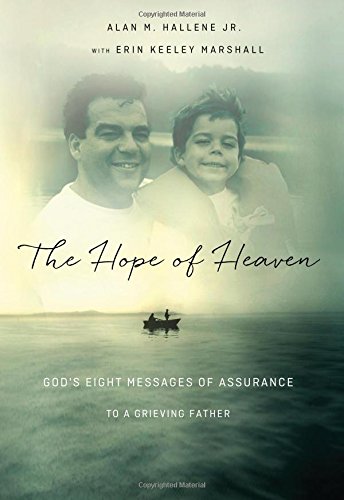
    Review: The Hope of Heaven: God's Eight Messages of Assurance to a Grieving Father

    The Hope of Heaven: God's Eight Messages of Assurance to a Grieving Father Hardcover – March 10, 2015


  • Hardcover: 176 pages
  • Publisher: Thomas Nelson (March 10, 2015)
  • Language: English
  • ISBN-10: 071802205X
  • ISBN-13: 978-0718022051

  • I found this book somewhat problematic. It's called Hope of Heaven by Allan M Hallene Jr. and it's a father's account of his son's suicide. So, yes it's important that the father has hope that his son will go to heaven. After all, Christians believe most suicides end up in hell because it is murder. I tend not to be cut and dried about where the souls of suicides go. We simply don't know the state of their souls or their minds.

    In this memoir, the dad finds his son's body after the son has hung himself. At that moment, God gives him a clear image that assures him that his son is at peace in heaven. We all know that need for spiritual assurance when someone dies. I imagine it would be even worse if the person has died unexpectedly or by suicide. There is also the whole question of parental guilt and responsibility.

    But the father gets these assurances. That could be a problem with me because I'm very wary of spiritual assurances. I'm generally wary of spiritual incidents, visions, dreams impressions etc as well. But something about assurances often makes me stop and ponder if the human mind wants to interpret things a certain way.

    Some books are hard to review because you know the writer has poured his soul out for the reader and because you know the writer is stil experiencing emotional pain you have no idea about.

    Another thing I'm wary about. The father is very calvinist/God's sovereignity. So he says stuff like God knew his son would kill himself because God knew his son was depressive and used those 23 years to help his son live and come as close to him so he could get to heaven. It's very subtle and I kinda get what the author is saying and maybe I kind believe him...but...wow. The father writes several times about his son's keeping his emotional pain to himself. And there are sections about the son being prone to these issues. I totally believe that there are pre-natal causes why some people are prone to depression. Perhaps there are genetic issues. And let's face it, God does not create bad genetics. It's a fallen world. There are also nutritional and even allergy-related depressions. And there are family dynamics. It's the family dynamics part of the equation that makes me uneasy. Even if the family isn't responsible for the depression, one wonders why this suicidal boy could not talk to his father. NOTE: I'm not saying the family could have helped him. I am not even saying the child feared his family so much that he couldn't tell them his heart. What I am saying is the father's repeated comments about how he tried to help his son just makes me wonder. Something about hearing something repeated a lot can do that. I'm just very cynical when it comes to Christians writing about themselves; I've seen too many self-deceptions. So wariness is not the author's fault, it's all mine.

    In fact the author is really good at telling his heart, discussing theology (particularly the fatherhood of God), and rightly dividing the thorny theological issues.  It's an interesting combination of theological paper, grief counseling, memoir, and PhD treatise with references.

    Anyway, all that said,  the comforting assurances, are very profound-- as assurances from God tend to be. And "if one is able to receive them", I think this book would be good for folks whose kids have committed suicide. Basically, this book would be considered a brave book in some Christian circles. And in other Christian circles, it would be considered a product of a wussy Christianity. It really all depends on one's denomination and how rigidly one thinks about things.

    I received this book free in exchange for a fair and honest review. 

    Saturday, February 28, 2015

    Review: Salad Love by David Bez

    Salad Love: 260 Crunchy, Savory and Filling Meals You can Make Every Day

    I have to say it: this book is a feast for the eyes. Heck, it's an invitation to a feast!

    Those of us who eat the same old things every day and wish to change our eating habits in the easiest most delightful way will love this book. This is a salad book that opens up one's mind. First, it reminds us of other foods that we've forgotten and ignored along the way. Secondly, it opens up one's mind to salads period.

    But first, the eye-feast: This food has the best food photography I've seen in ages. The photos are not flashy or anything. They are pretty basic: a wonderful, wildly colorful salad on a plain white dish.  Each page has a large photo and a tiny list of the required ingredients at the bottom. Often, the ingredient list isn't necessary because a picture is worth a thousand words and the photos are pretty self-explanatory. Along with the photo and the ingredient lists on each page, there are also two circular insets. The smaller inset (at the top of the photo) contains only one word which states if the salad is Raw, Pescatarian, Omnivore, Vegan, or Vegetarian. The slightly larger inset diagonally opposite the first one and at the bottom of the photo indicates how to transform the salad in some way. For instance, how to change that particular raw salad to an omnivore alternative, or how to change a pescatarian salad to a vegetarian alternative, or omnivore to vegetarian. For instance, the pescatarian Tuna, zucchini, broccoli and black olive salad can be turned into a vegan alternative by replacing tuna with canned beans. By doing this, each salad can be made in two different ways. So although there are 260 salads, the inset with alternatives pretty much doubles the total number of salads.

    The salads themselves are a perfect blend for taste and health...and satisfies the need for different mouth-feel.

    Before the photos, we have chapters which are no more than two pages long. Seriously, this is a cookbook for those who do not like to actually read cookbooks. One page shows pictures of the items discussed in the chapter, and the other page is a short description.

    The first chapter of the book is called The Base. The base of any salad -- as described here-- are greens, grains (couscous, rice, barley, etc), vegetables cut into small pieces, and vegetables shaved to look like ribbons or spaghetti. He doesn't list noodles here but since noodles appear in some of the salads, I'll include that as a base as well.

    The second chapter is called Vegetables and Fruits. The author states these should take up about 25% of one's salad. So non-veggie-lovers should love that. The veggies are generally raw and the pics of vegetables show an assortment of the veggies and fruits that the author typically uses.

    The third chapter entitled protein states that one cup or 25% of one's salad should be dedicated to protein and again there are pics of protein: meat, eggs, beans, cheeses, fish.

    The fourth chapter is entitled toppings; the fifth chapter is "Fresh Herbs." The sixth is Dressings & Spices. This is a fun chapter because it features tiny little recipes for dressings.

    Then there is a chapter on tools needed in the kitchen.

    The recipes are placed in four sub-sections:  Summer, Fall, Winter, Spring

    For the most part, the salads don't need a lot of preparation. One might need to boil some rice or noodles here and there But all in all, this is a cookbook that takes all the work out of preparing a meal. And if one already has ingredients on hand, making these salads shouldn't take more than 20 minutes or so.

    Highly recommended.
    I received this book free in exchange for a fair and honest review.


    Wednesday, February 18, 2015

    Review: NIV Proclamation Bible: Correctly Handling the Word of Truth


    The Proclamation Bible is not a study Bible per se. It merely contains articles about how to teach the Bible.
    Some of the articles are a bit problematic. Why? Because they are written from a Christian Teacher's perspective for Christian Teachers. And these folks are very very very educated theologians.  This means they know their stuff. But it also means that some of the articles are written in graduate theology-ese. Because while the writers know their stuff, they don't seem to know how to write about what they know to people who don't already know what they're talking about. These theologians are very aware that they are teachers and therefore knowledgeable.  They want to preach the word truly and rightly. And they are writing to other teachers.  So there is definitely a feel of a great US teachers versus all those other Christians (sheep) divide. It can be off-putting but I don't think it's meant to be.

    The basic Bible set up:
    A General Preface
    Editor's Preface
    Contributors

    What is the Bible by Mark D Thompson, Principal of Moore Theological College, Sydney

    A Bible Overview by Vaughan Roberts, Rector of St Ebbe's Church Oxford, and President of Proclamation Trust

    The Historical Reliability of the Bible by Dirk JongkindResearch Fellow in New Testament Text and Language, Tyndale House, Cambridge, and Deputy Senior Tutor, St Edmund's College, Cambridge

    Finding the "Melodic Line" of a Book by Tim Ward, Associate Director of the Proclamation Trust Cornhill Training Course, London

    From Text to Doctrine: The Bible and Theology by Peter Adam, Vicar Emeritus of St Jude's Carlton, and Canon of St Paul's Cathedral, Melbourne

    From Text to Life: Applying the Old Testament by David Jackman, Past President of the Proclamation Trust, London

    From Text To Life: Applying the New Testament by Charles Skrine, Curate at St Helen's, Bishopsgate, London

    From Text To Sermon: Preaching the Bible by Christopher Ash, Director of the Proclamation Trust Training Course London

    From Text to Study: Small Groups and One-to-Ones by Leonie Mason, Trainer of Ministry Apprentices and Bible Study Leaders at St Helen's, Bishopsgate, London

    Biblical Interpretaton: A Short History by Gerald Bray, Research Professor of Divinity at Beeson Divinity School, Birmingham, Alabama, and Director of Research at the Latimer Trust

    Then the Bible itself begins.

    Each book has an introduction which shows
    The Message
    Structure
    Points to Consider
    Commentaries
    The layout of the Bible books is easy on the eyes with a good typefont. The type is dark and incredibly readable, unlike the NIV Spiritual Renewal Study Bible which has very light printing. The Scripture is placed in two columns on each page with cross-references in the middle of each page. The bottom of the page has definitions or alternate translations. There are sub-headings within chapters which will help guide the reader. There are also cross-references listed under the sub-headings if a scene or event is duplicated elsewhere. There are two ribbons for placeholders. Poetry is written in poetic form. Scriptures that are quoted in other Bible books are also set off in poetic form. The words of Jesus are not in red.
    There is a Table of Weights and Measures
    Concordance
    Maps

    It's a solid hardcover Bible.

    For better or worse, the key word throughout most of this book is training; Theologians training others on how to read Scripture, how to understand Scripture, how to teach Scripture, and how to hear the Holy Spirit. There are many patterns to learn here, all of which will be helpful to some or all Bible teachers. But which could become almost legalistic and prohibitive if doggedly followed.

    The best thing about this Bible are the introduction to each of the Bible books. They are very insightful and the vocabulary is accessible to anyone. Those introductions alone are worth the price. The second-best thing are the articles in the front of the Bible about how to understand, read, and teach the Bible. But I say second-best because I suspect the folks who most need those articles might be the folks who can't get through them.

    I can understand a book written on a college graduate level. But I cannot imagine these articles being accessible to pastors who may not have had much college. Some of the article writers write as if they are writing a graduate thesis! At that time, one feels as if one is wading through a tome on linguistics written by a computer because the writer seems to have forgotten how to write conversationally. Other times the writer seems to be "speaking to the choir" because he is using jargon -- even though he thinks he is not-- and terms only church folks use. So this book will bless many people. It's a Bible after all. But it would be most useful for the super-educated types and for new pastors who might want to know and use certain patterns in their teaching and preaching.

    As a Charismatic Christian, I would probably dislike some of the patterns recommended by some of these teachers but a good workman knows how and when to use the rules and how and when to put them aside. Also, as someone who thought Calvin was a means-spirited and possible false prophet, I don't know if I can trust his pattern of exegesis as much as Gerald Bray does.

    But all in all this is a good book.  Those who like the NIV translation will like it.
    I received this book free in exchange for a fair and honest review

    Saturday, February 14, 2015

    Movie Review: August Eighth


    August Eighth 2012 Russian action fantasy drama Screenplay by Michael Lerner. Directed by Dzhanik Fayziev. Kseniya (Svetlana Ivanova) ,  Artyom (Artyom Fadeev) 2 hours 12 minutes

    Okay, to begin with, this film is pure propaganda. But what wonderful propaganda it is! I debated whether this review should be included because the fantastical part of the film is understood to be fantasy. In that way, this film reminded me of Pan’s Labyrinth because the fantasy is a child’s reaction to the warring world all around. So if Pan’s Labyrinth is fantasy, then this is as well.

    The story begins with Artyom in his fantastical alter-ego of Cosmoboy. His noble, self-sacrificing sidekick Kind Robot is helping him battle Robot Darklord. The scene shifts to a theater where Artyom is watching an amateur theatrical production about dragons. After this, Mom and Artyom are on their way home discussing family dynamics. Just at that moment, Darklord pops up in Transformers mode. Artyom warns his mom but gets rebuked with “Why do you always talk about robots when I want to talk about something important?” Not that mom should talk, she also has moments when the fantastical emerges out of the blue.

    The something important that Kseniya wanted to talk about is Egor, her new boyfriend. Truth to tell, Egor’s full of himself. But to be fair, he’s got a good job and so he’s a big find for the artistic single mom Kseniya. Besides, she’s only in her early twenties and her son is seven.  She hasn’t had a chance to grow up yet. So I cut her a lot of slack.

    When Zaur, Artyom’s dad, an Ossetian “peacekeeper” asks Kseniya to send their son to Zaur’s parents, Kseniya doesn’t want to. There’s a conflict going on in that region. But heck the conflict has been going on for 150 years, says ex-beau. Nothing’s gonna happen. Kseniya’s still not sure but hey, Artyom’s dad misses him, the grandfolks are getting old, AND boyfriend with the good job did after all invite her to go on a vacation with him.  So she sends Artyom off, trusting in Zaur’s promise that he’ll send their son back should trouble arise.  

    There’s this wonderful bucolic scene with cows, happy peasants, loving grandfolks, and women in babushkas. And then, wouldn’t you know it? The Five Day War threatens to break out. And annoying Ex refuses to send the child back.  Seriously, the men in this movie are useless. And so Kseniya’s quest to go to war-torn territory to get back her son begins.

    Folks, this is one fun movie! Mother's Love and War battles! IF you like war movies, don't miss this one on netflix.

    Friday, February 13, 2015

    Review: The Secrets of Life and Death by Rebecca Alexander


    The Secrets of Life and Death
    Rebecca Alexander
    ISBN: 978-0-8041-4068-3
    Broadway Books
    US $15.00


    The Secrets of Life and Death is a good summer read for anyone who likes mysteries and women in jeopardy books. It's also paranormal, urban fantasy. This is a safe book for anyone who wants to do some good bloody escapist reading. It is historical urban fantasy and based on the life of the murderous Elizabeth Bathory, the life and travels of Edward Kelley and Dr. John Dee. 

    This is a quick, easy read for folks who might like supernatural mysteries of the undead variety. And it does make one ponder certain deep questions like: “Can a religious person be deceived by a demon?” and “Why is living so important?” 

    Those who like historical fiction will love discovering more about the times and mores of Elizabeth Bathory and the royalty of Poland. Those who like urban fantasy will find it a page-turner. There's even a good romance. It's dark fiction but light reading.

    It left me a little cold because there were moments that felt very high concept generic blockbuster-ish. But if you want a good semi-predictable read, this is a good book. I did get a bit offended at the depiction of the religious character Edward Kelley who is the counterpart of “good witch” Maggie and who is the typical deluded superstitious religious Christian who  is somewhat deceived about angels, herbalism, and (of course) women. But hey, it's par for the course. 

    This book was sent to me free in return for a fair and honest review. 

    Sunday, January 25, 2015

    Review: Miracle on Voodoo Mountain by Megan Boudreaux

    Miracle on Voodoo Mountain
    A Young Woman's Remarkable Story of Pushing Back the Darkness for the Children of Haiti
    By Megan Boudreaux
    Thomas Nelson Publishing
    ISBN: 978-0-5291-1094-7
    $22.99

    Whenever I read Christian non-fiction, especially testimonies and memoirs, I always approach them with extreme cynicism. This is because as a Christian I've been burned by Christian platitudes and self-righteousness, and as a writer I've honed an ability to sense the ring of truth. Thus, my spiritual "BS" meter is pretty highly-developed. Therefore, if I read a book and say it's good and believable, I am to be trusted. This is a really really good book and it does what good Christian testimonies should do. It highlights the power of Jesus Christ in the world as He works through His people. And it shows us how needy, evil, and lost the world is.

    It's the first-person memoir written by Megan Boudreaux about how she began working with and for poor, abused, orphaned, and/or enslaved children in Haiti. Throughout her narrative, Boudreaux is real, strong and good without being pretentiously pious, and also very informative about how dangerous uninformed American Christian charity can be.

    After having repeated dreams of a tamarind tree in a suburb in Haiti, Megan decides to give up her perfect job and to follow what she feels is a call from God. In Haiti, she's a bit at a loss where to begin or what exactly she has been called to do. But one small encounter with a restovak -- an enslaved child-- starts her journey. One thing leads to another and soon she is feeding starving children, building schoolrooms, and being threatened by voodoo priests. She encounters corruption in various forms and discovers how poor children and well-intentioned Christian churches are used by false orphanages and child traffickers.

    All the while, Boudreaux writes honestly, humbly, and in a conversational engaging style.

    I'll admit, though, that the title turned me off initially. I avoid anything that seems hyperbolic. But the book really is about a great work done by a young Christian woman. I highly recommend this.

    This wbok was sent to me free by Booklookbloggers in exchange for a fair and honest review.

    Saturday, January 03, 2015

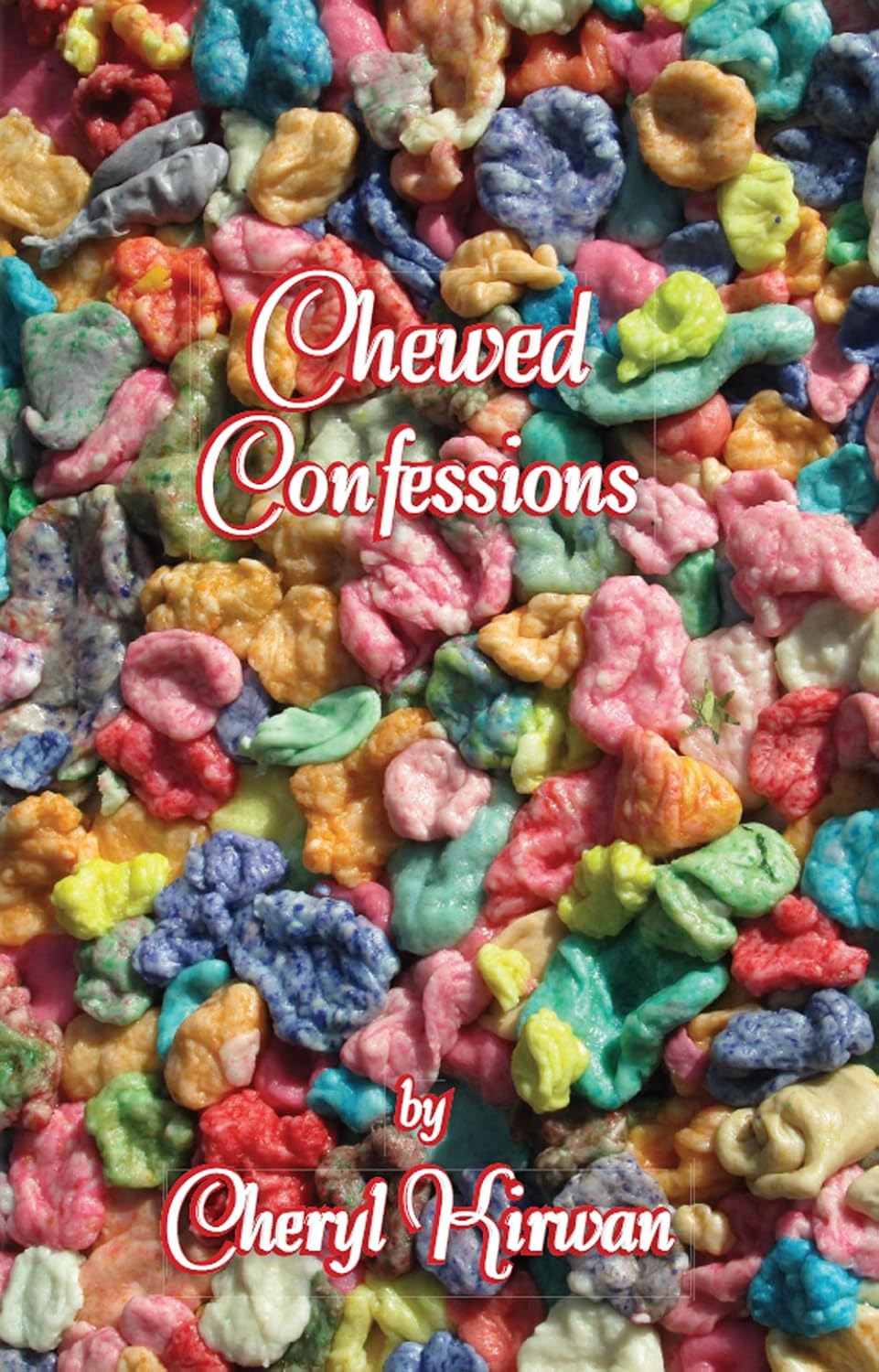
    Review: Chewed Confessions by Cheryl Kirwan

    • Chewed Confessions 
    • by Cheryl Kirwan

    • File Size: 337 KB
    • Print Length: 178 pages
    • Publisher: CreateSpace Independent Publishing Platform; 1 edition (April 22, 2013)
    • Sold by: Amazon Digital Services, Inc.
    • Language: English
    • ASIN: B00CHCQO68

    I love omnibus novels, a collection of short stories composed of characters who are connected with each other by chance, location, or situation. In omnibus novels, a secondary character in one story will become a main character in another. Sometimes the omnibus is complicated as in Revenge: Eleven Dark Tales by Yoko Ogawa, where characters are unnamed, inter-connected to the extreme (yet often strangers to each other), and who affect each other's lives for the worst.

    In Chewed Confession, characters are connected in a straight-forward linear manner. In this case, the characters in these stories are often friends, family, colleagues, or acquaintances. Thus the main character of one story might casually call a friend or family member and this friend becomes the main character in the following story. This is generally the pattern throughout.

    The narrators in each character study are different flavors of gum. So the reader encounters two new characters with each story: a character and a gum with a flavor name. Hence we have narratives from Cherry ubilee, Minty Chocolate, Peppermint, Clove, Cinnamon, Mega Mint Delight, Summer Mint, Triple Bubble, and Fruity Explosion. They relate the lives of Jason, Peter, Abby, Piper, Rita, Matthew, Artie, Rudy, and Lester -- people of different ages, and sexes.

    Despite the difference in flavors, the wads of gum generally have the same speaking voice and personality. They also have the same destinies: they are removed from a wrapper, chewed in distinctive styles depending on the personality and stress of the chewer, then discarded...either on the ground or in a bin. The human characters are either stressed -- because of divorce proceedings, civil lawsuits, dating and love and relationship issues-- or are going through life causing stress to others. The wads of gum describe the lives of the human chewers as they describe their own lives as they are chewed, tongue-throttled, etc.

    This is a good collection of short stories. They work together as an omnibus novel although the overall feel is of a series of scattered events in the lives of disparate characters. In this way, they are like character studies and the wad of gum's summation at the end of each story gives a moral of the life event the reader has witnessed.  This can be a bit much but I suppose that gums chew on what they have witnessed or seen in the lives of their human chewers and moralizing become part of their personality as they share with other gum acquaintances what they have digested in their short lives.

    It's a fun book. 

    Friday, January 02, 2015

    Review: A Plague of Unicorns

    A Plague of Unicorns
    Jane Yolen
    ISBN: 978-0-310-74648-5
    Zonderkiz
    US$15.99

    Even as a child, I’ve loved stories about the trials, journeys, and quests that boys endure. I’m not sure why. I’d like to think I focus so much on stories with boy teen protagonists for some wonderfully sane and enlightened reason. But I don’t think that’s wholly true. I suspect some part of it is my personality but the other part might simply be that I grew up on the stuff: Shakespearean characters, Grimm fairytales, cultural folklore, and all those tragic Bible princes tend to be pretty boy-focused.

    The golden apples in Cranford Abbey haven't been particularly useful and so the monks and abbots have allowed the unicorns to nibble them. However, when Abbot Aelian arrives, he brings with him his greagrandmother's recipe for Gold Apple Cider. The unicorns and their nibbling will have to go.

    But unicorns are not easily gotten rid of. Even though heroes come from many nations to battle them.

    James is not a hero. He is a very energetic very curious future duke who continually pummels everyone for miles around with questions, especially unanswerable ones. He is the one who figures out how to get rid of the unicorns.

    This is a fun humorous, little book. The vocabulary is easy enough for middle readers, although it takes place in a Roman Catholic world, and there are Roman Catholic words scattered throughout. Theis might be problematic for some children who have never heard words like abbeys, abbots, and turrets thrown around. But one does not have to be Roman Catholic to enjoy it and a child who reads about knights and dungeons will enter the worldbuilding of this story easily.

    There is nothing offensive to Christians to it, no wizards or ogres. So Christian readers who are against certain fantastical elements should like it. It's not religious but people with extreme atheists or extreme Islamic beliefs might be upset about mentions of the Bible.  

    The illustrations are black and white and nicely-done. Recommended.


    Wednesday, December 31, 2014

    Review: Authority in Prayer: Praying with Power and Purpose

    Authority in Prayer: Praying with Power and Purpose
    by Dutch Sheets
    Bethany House
    ISBN: 978-0-7642-1173-7
    US $15.99


    Over the ages, there has been much confusion about “authority” in the Christian church. For many denominations like Roman Catholicism, it implies human hierarchy. For some churches, the word  “authority” conjures up ideas of Apostolic Succession. The author of this book is writing about the word for a charismatic, full-gospel, and pentecostal readership. Here the meaning described the Christian believer’s authority over a particular sphere God has given him.

    But there is still not a general consensus about how much authority the believer has. Generally speaking, these spheres of authority include authority over certain kinds of physical and mental states such as disease and the power of sin; authority over demons, and authority over certain groups such as family, church, geographic regions.

    Dutch Sheets has written a book which shows the Biblical reasons for his belief about authority in prayer. He describes the purpose of God in creating Man, and what was lost when the First Adam fell. There are doctrinal definitions of authority versus power, and Satan’s loss of Authority over certain spheres because of Jesus’ perfect life, death, shed blood, and resurrection. Then he describes how Jesus Christ --the Second Adam-- returned that authority to us. There are also many examples, testimonies, and anecdotes about how authority has helped in the lives of Christians. Some of these examples show Dutch Sheets himself and/or some of his friends working behind the scenes to affect the outcome of the nation. These examples might sound a bit arrogant, far-fetched, wild-eyed, or innocent to readers who don’t believe that God works through people.

    But the author appears so humble -- and never states that he alone can use his authority in Christ-- that one can easily believe these testimonies. Those Christians who do not know anything about the authority of Christ might be put off by the fact that someone believes in supernatural answers to prayer. They will also have to put aside some of their Calvinist fatalism or change some of their definition of God’s sovereignty. (The book doesn’t go overboard into dominionism.) Certainly, people raised to believe that suffering is ordained of God and must be patiently endured will have to truly ponder the choice and power inherent in this doctrine of authority.

    There is much humor in this book, and it feels like a conversational memoir. There are also Bible verses that explain this doctrine. This is definitely a good book to read if one wants to understand a balanced presentation of the Christian doctrine of authority. Recommended.

    I received this book for free in exchange for a fair and honest review.

    Wednesday, December 10, 2014

    Review: Discipleship: Living for Christ in the Daily Grind by J Heinrich Arnold


    Review: Discipleship: Living for Christ in the Daily Grind
     by J Heinrich Arnold


    • Print Length: 311 pages
    • Publisher: Plough Publishing House; New Expanded Edition edition (January 2, 2014)
    • Sold by: Amazon Digital Services, Inc.
    • Language: English
    • ASIN: B00IT0CIGC


    Okay, first things first: I never knew who  J Heinrich Arnold was before receiving this book to review. As anyone who reads my blogs knows, I avoid reading much modern theology because I find the more popular ones -- by famous televangelists and theologians-- to be a tad empty. Not that I'm that full or that deep, but I've read enough to know that other theologians --of old-- wrote about certain topics with more knowledge, maturity, subtlety etc.

    So imagine my surprise when I discovered the author of this book (or collection of writings) was born in 1913 and died in 1982. Yes, my kind of theologian! He also served as an elder in a Christian communal movement called Broderhuf. I don't know much about the Broderhuf except for being in their neck of the woods one day in our family travels. But I do have a soft spot in my heart for Christians who turn their backs on the world and try to live holy simple communal lives. Unless it gets all cultish and oppressive.

    The book is divided into three large sections (The Disciple, the Church, the kingdom of God), which are further divided into subsections such as (under the Disciple) The Inner Life, Repentance, Conversion, Faith, Dogmatism, Commitment, Reverence, Surrender, Sincerity); (under The Church) Community, Gifts, Forgiveness, Unity, Baptism, Lord's Supper, Family Life, Illness and Death, Evil and Darkness, World Suffering; and (under The Kingdom of God) Jesus, The Living Word, The Cross, Salvation, The Holy Spirit, the Kingdom of God.

    This edition has the Discipleship book, with expanded sections such as taken from different works and from letters. As such, there is a flow to the paragraphs in the sections but sometimes....not. Because the excerpted letter paragraphs are placed in the chapter without introduction.  Still, its good to see these excerpts from the letters which show a very kind pastoral heart...which can be firm if need be.  

    One would think that a spiritual leader of people committed to living apart from the ruin hypocrisy of Christendom would be very hard and dogmatic. On the contrary. In the section on dogma we see a person who respects Christian dogma but who seeks primarily that those in his fellowship find the relationship with Christ.

    This book is really good. I love what he says --in his firm way-- about love, marriage and sex.

    A couple of examples:

    "Sex is man's secret, something that he feels touches on his inmost being. Every disclosure in this sphere reveals something intimate and personal and lets another person into his secret. This is why the area of sex is also the area of shame: we are ashamed to unveil our secret before others."

    Or this (from a letter):

    "Your question, 'Why do I feel attracted toward this boy if he is not meant for me but for someone else?' is a bit of a rebellious one, It accuses someone higher than yourself. Ultimately, it accuses God. Human nature being what it is, we often feel attractions that we have no choice to reject. That is simply part of our human weakness. Who is destined for you, or whether or not someone is destined for you, is not for me to say. The important thing for you is to give your life to Jesus."

    Can you imagine getting a rebuke like that from your spiritual leader? And keeping the letter?

    He must have been a very great man.

    I highly recommend this book. A copy was sent to me by Plough publishing for a fair and honest review.

    Monday, December 01, 2014

    Review: Gift of Truth by Robert Fleming


    Gift of Truth 
    by Robert Fleming
    Urban Christian

  • File Size: 1110 KB
  • Print Length: 288 pages
  • Publisher: Urban Christian (February 1, 2014)
  • Sold by: Amazon Digital Services, Inc.
  • Language: English
  • ASIN: B00HG21C4S


  • Robert Fleming is one passionate writer. He understands the history of African-Americans and the history of the Black church and his knowledge abounds in this novel about a minister who tackles racial religious compromise in the South.

    We've met this minister before in Fleming's first novel Gift of Faith. In that novel, we were more involved with the main character's/narrator's life as he recovered from his wife's suicide and her murder of his children.

    In this novel, he is more of a spectator. He is healed of the wound caused by his wife's betrayal and suicide but now he has to encounter betrayal on an even larger scale. Trouble is, discernment and truth is needed.

    His friend Reverend Peck, another minister, has called him down to Alabama; a self-styled prophet has arrived on the scene and has sheep-napped the minister's flock. The prophet, Wilks, comes from a long line of shysters and con men and he performs flamboyant healings in front of frenzied audiences.

    I'm trying to review this book without giving away spoilers because there are twists galore!

    Complicating the problem of flock-nabbing are the racial and socio-economic tensions between the poor Black farmers, the rich white agribusinessmen, the KKK, and white lawmen. For the religious Black men, there are great obstacles and temptations. Social compromises to protect one's reputation or one's life, sexual temptations, monetary temptations, and the compromising of truth.

    This is a very good novel. The challenge of being a prophet --especially one who is called to battle social ills-- echoes both the lives of prophets in the Bible and the lives of African-American activists such as Martin Luther King, Malcolm X, and others. Of course the prophets in the Bible are totally holy, but the prophetic activists and great ministers of Black history have been flawed.  

    I had a few nits of course. The main one is that the author is so knowledgeable about African-American culture and history that sometimes there feels like way too much teaching going on for a novel. It's not bad, of course, and one does get the feeling the book is written to honor great Black heroes and musicians. But Mr. Fleming is a cultural historian and that kind of writing is to be expected.

    A few writers might feel the author is picking on certain types of Christians i.e. pentecostal types. But I don't think that Mr Fleming was doing that. But I do think he is saying that Christians can sometimes be like sheep if they don't discern the truth and stand up for it.  Some Christians might be offended by events in the story but I encourage them to read through the book and finish it. As I said, there are some good twists. 

    Wednesday, November 26, 2014

    Review: Evening Prayers For Every Day of the Year by Christoph Friedrich Blumhardt


    Evening Prayers For Every Day of the Year by Christoph Friedrich Blumhardt


    Growing up with the Book of Common Prayers, I have nothing against written prayers per se. Some of them are lovely and the best written-in-stone (so to speak) prayers are usually like perfectly distilled, perfectly chistled heartfelt communication from the depths of our spirit. As a penteocostal, charismatic, Christian, I also love a good spontaneous prayer. Who knew there was a book of written prayers that was perfect for folks like me!

    I've never heard of Christoph Friedrich Blumhardt but apparently (at least from the cover) he was quite influential with folks like Karl Barth and Boenhoeffer. And I can see why.  


    First, the prayers are addressed to a living God who wants to do wonders in the world. They are prayers which seem to be born from someone keenly acquainted with the work, love, and power of the Holy Spirit. This is amazing to me. One cannot read these daily prayers and the Bible verses connected with them without developing a spirit of expectancy.  Blumhardt repeatedly asks God to show His power, His love, His healing, His Wisdom.

    Secondly, the prayers in this book are not necessarily evening prayers. There are very few prayers which actually should only be said at night.

    Thirdly, the prayers are very very very insightful and although they don't read like treatises, they very well could be. The prayers are heartfelt and one often feels as if one is overhearing an intimate private conversation between a holy saint and God. But the prayers pack so much wonderful theology that they enlighten the heart and mind as one reads them.  

    Fourthly, the prayers are accessible. The language they are written in are modern and conversational. A child of ten or eleven can understand them as well as an adult. The super-theologically-educated will like it as well as those who know little about God.

    Fifthly, the theology is presented in a way that will not offend anyone. Okay, unless one is extremely legalistic and picky about some pet theology, one will not find anything to argue about.

    Lastly, this book is a classic. I didn't know the author until I got this book. And now I know why this is a classic.

    I highly highly highly recommend this book. I have the book in hardcover and I guess my only nit is that the kindle is so expensive. ($8.49) Especially for a Christian book.  But that's my nit, I guess.

    I received this book freely in exchange for a free and honest review.


    Blog Archive